
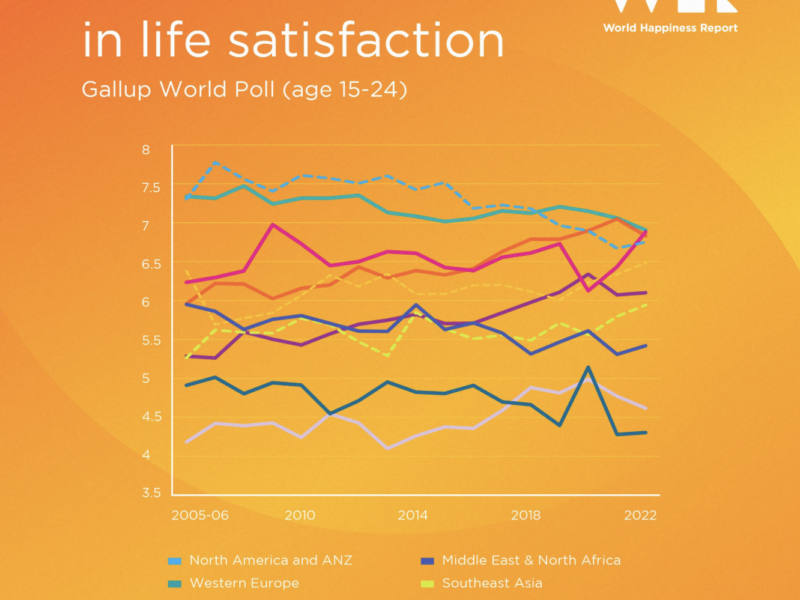
For the first time since its publication, the World Happiness Report (WHR) provides a comprehensive analysis of happiness trends across generations, giving separate rankings by age group. Gen Z’s wellbeing is down in the Anglosphere, Western Europe, and South Asia but up in Central and Eastern Europe. Notably, the USA has fallen out of the top 20 ‘happiest countries’ for the first time, driven by a significant drop in the wellbeing of Americans under 30: it now ranks 62nd in the world for the young! But why are young adults in the West so unhappy? Social media has been publicised as the cause of the decline in Gen Z’s mental health and happiness, but it can’t be the only reason. For Mental Health Awareness Week, we looked into this drop – and find it’s a mystery. Dr Michael Plant, Research Director at the Happier Lives Institute and Fellow at the Wellbeing Research Centre, Oxford University, points out the problem without laying all the blame on social media: “Over the past 20 years, we have seen young people become less happy in North America and Western Europe. But, over the same period, youth wellbeing in Central and Eastern Europe has gone up by more. Social media is everywhere. I expect it’s one cause of reduced wellbeing, but it’s hard to see how it could be the only culprit.” What does explain the drop in Western countries? Researchers aren’t sure.“There is no consensus among academics regarding the role of social media, at least from a global perspective. Interestingly, regions like Central and Eastern Europe, with similar levels of social media use, exhibit divergent wellbeing trends. In general, it is not clear yet what is driving negative and positive trends in different parts of the World, and this is partly due to limited data availability in non-Western countries,” says Dr Jose Marquez, a WHR chapter author on youth wellbeing. Prof Lara Aknin, Co-Editor of the WHR, emphasises the multifaceted nature of the issue. “Pinpointing a single …
Source: MyPR International
