
Fire! The role of heat and light in African Art
Standard Bank Gallery
29 January – 31 December 2013
This exhibition on the role of heat and light in African Art is on display at Standard Bank Gallery until the end of the year.
The ethereal nature of fire has enthralled the human race for millennia. It can be seen, heard, felt and smelt, but it cannot be grasped. This exhibition of historical and contemporary African art drawn from the Standard Bank African Art Collection, housed at the University of the Witwatersrand, explores the role fire has played in African cultural expression. The exhibition alludes to the distinctive attributes of fire: light, heat and smoke, as well as associated natural features such as the sun and lightning. It explores the role that fire – in all its manifestations – has played in aspects of African life, including the ecology, economy, social organisation, politics and religion.
The control of fire has arguably been the single most important “shaper” of human culture, setting us apart from other species. More fundamental than the wheel, and more versatile, the use of fire has unleashed alchemic processes which have played a significant role in the development – for better or worse – of humankind. Heat enabled human beings to cook their food and to make natural substances materials more durable: firing clay pots; hardening and decorating wooden items; forging metal tools, ornaments and weapons; and transforming sand into glass. The heat and light generated by fire enabled our earliest ancestors to extend their waking time deep into the night. This is believed to have played a role in facilitating social gatherings and the development of social and religious practices.
The beautifully crafted clay pots on exhibition demonstrate the transformative power of fire and various stages of the manufacturing process. Once pots have been patiently shaped they are fired in a shallow pit to harden the clay. The pot is then re-fired in a bed of grass to blacken it before it is polished to a high gloss with a smooth pebble and animal fat.
About 10,000 years ago humans discovered a way to extract iron and copper from ore and to utilise fire to forge metal. This enabled the production of robust tools: hoes used for cultivating crops, axes and adzes for hunting, food preparation and defence. As a highly desirable commodity, metal ingots – in a wide variety of shapes and forms – were produced and used as currency, facilitating the exchange of goods across the continent. The exhibition includes a range of material associated with metal work, including bellows, ingots, gold weights and scales and iron implements.
Fire has the potential to wreak havoc. The devastating fires that sweep through informal settlements, resulting in many people losing their homes and earthly possessions, and the veld fires that cut blackened swathes across our landscapes bear witness to the destructive nature of runaway fires. On the positive side, fire helps to maintain the equilibrium of the earth’s ecological system. It stimulates the growth of some plant species and is required for the germination of seeds in others. It is estimated that about 70% of South Africa’s eco-systems are fire-adapted: they need to burn in order to maintain their ecological integrity
While the power of fire has been utilised for the good of humankind and the environment it is sometimes also harnessed to bring harm. All too often we hear of xenophobic attacks in which people have been wilfully burnt to death; service delivery protests in which facilities, vehicles or garbage – and even, as in the recent Western Cape farm workers’ strike, vineyards – are set alight.
The most fundamental form of fire we experience in our daily lives is the sun – the flaming mass that sits at the centre of our solar system. The sun facilitates just about all life on earth: people, animals and plants need heat and warmth to flourish. The sun has played a central role in widely diverse cosmologies and been an object of veneration in cultures throughout human history. As with fire, the sun can also be a destructive force. Too much sun causes drought. With no rain or water to counteract the heat of the sun, living creatures dehydrate rapidly and die, and plants wither and crumble away. Too little sun is a problem too: plants need the sun to grow, without plants people and animals of all sizes would starve and lose the means to create shelters, clothing and other life essentials.
Heat, smoke and fire are associated with various African traditions, rituals and beliefs. In the early 20th century in southern Africa, the concepts of cool (positive) and heat (negative) regulated much of African social behaviour. Menstruating women were considered ‘hot’ and consequently had to avoid the cattle kraal in order not to contaminate the milk. In cultures that practise rain-control it is often believed that rain does not fall if the earth is ‘hot’, that is, if taboos had been broken. To remedy this, these groups enact cleansing and cooling rituals to prepare the earth for rain, or to attract rain. While the practice of rain-control differs from one group to another, some prohibit the killing of large snakes during the rainy season but may sacrifice animals to attract rain, and kee p lightning away.
Smoke may also be used to attract rainclouds or to signal the higher powers that rain is needed. In many African religious practices smoke is used as a part of ritual activity, to induce trances, make contact with the ancestors, or promote spiritual enlightenment. Beautifully decorated wooden and clay pipes, like those on exhibition, were seen as signifiers of social status, and tobacco was offered as a wedding gift.
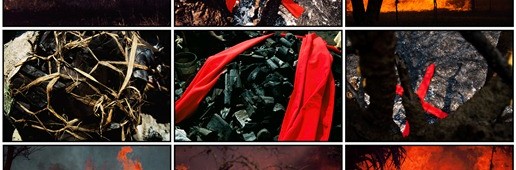
Georgie Pappageorge’s Inferno captures humankind’s entrancement with the spectacle of fire – flames and smoke – tempered by the fear of conflagration. Dianne Victor’s fascination with fire goes beyond the spectacle: her delicate and ethereal Smoke Portraits are made with the deposits of carbon from candle smoke on white paper.
Fire!The role of heat and light in African Art offers a fascinating insight into the meaning and significance of artefacts included in the Standard Bank African Art Collection and the Standard Bank Corporate Art Collection. It is an exhibition that is sure to make visitors reflect differently on the manifestations of fire that they encounter in their daily lives.
Fire! The role of heat and light in African Art is curated by Barbara Freemantle, and runs at the Standard Bank Gallery, corner of Simmonds and Frederick Streets, Johannesburg, until 31 December 2013. The Gallery (Tel: 011 631 4467) is open Mondays to Fridays, 08:00-16:30; on Saturdays, 09:00-13:00; and is closed on Sundays and public holidays. Admission is free. For more information about Standard Bank Gallery see www.standardbankarts.co.za.
More Info link:: https://www.standardbankarts.co.za/
Twitter:
Facebook:
YouTube:
Author: Fiona Gordon from The Famous Idea Trading Co..
No of Images Uploaded: One
Click on each to see larger image.
 Georgie Pappageorge Inferno 2011 Lightjet print on paper – part of Fire! exhibition at the Standard Bank Gallery Photographer: Courtesy Standard Bank |
Submit your press release to MyPR.co.za.
Track Your Press Release HERE:
Check Online Visibility
Verify where this release is currently indexed:
 Entries close at midnight for Val de Vie race