
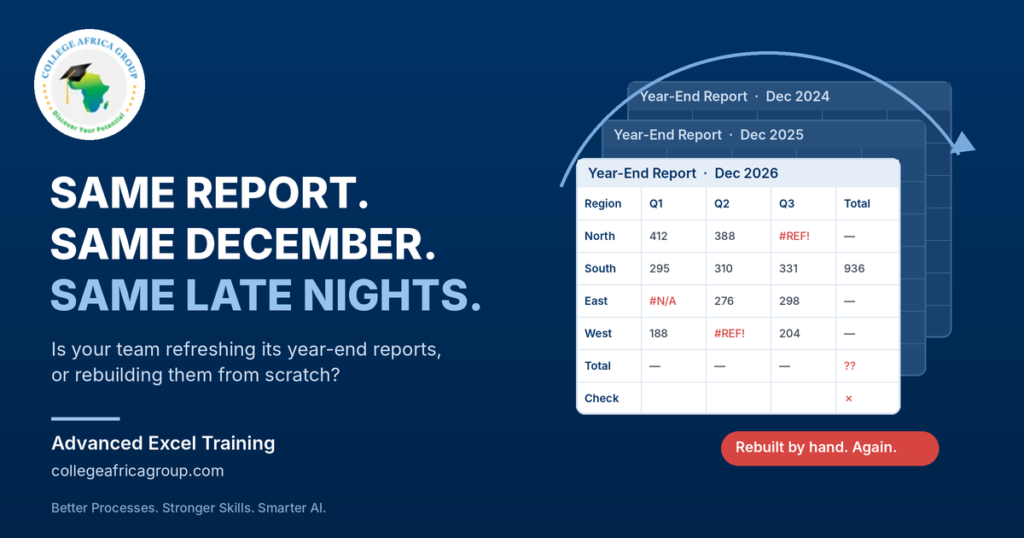
Johannesburg: As year-end approaches, many finance and reporting teams across South Africa are bracing for the same long nights: copying data between workbooks, fixing broken formulas and rebuilding reports that were built by hand last year, and the year before that.
According to Arnold Muscat, Managing Director of College Africa Group (CAG), the problem is rarely a shortage of effort. “Most teams don’t have a time problem at year-end. They have a process problem that shows up as a time problem,” he says. “The same report gets rebuilt manually every cycle because nobody has had the chance to step back and fix how it is put together.”
Where the time goes
Muscat points to a few patterns CAG sees repeatedly when working with finance, HR and operations teams:
– Data is pasted in from system exports rather than connected, so every refresh starts from scratch.
– Key formulas live in one person’s head, and the workbook breaks when that person is on leave.
– Lookups, totals and reconciliations are checked by eye instead of with built-in controls.
– Reports are formatted manually each month, rather than built once as a reusable template.
“This is where Advanced Excel skills pay for themselves,” Muscat says. “When a team learns to structure its data properly and use tables, reliable lookup formulas, summaries and simple checks, the year-end pack stops being a rebuild and becomes a refresh.”
Fix it before the pressure starts
His advice to managers is to act before the crunch, not during it. “December is the worst time to redesign a report. October and November are the right time. Pick the one report that causes the most pain, and fix that properly first.”
He also cautions against jumping straight to automation or AI tools without checking the basics. “If the source data is messy, automating it just produces wrong answers faster. Get the structure right, then automate, and always validate the output against the source.”
Practical steps for finance managers
1. Identify the two or three reports that take the most time at year-end.
2. Check whether the source data is clean and consistently structured.
3. Replace manual copy-and-paste steps with connected, refreshable data where possible.
4. Add simple control checks so errors are caught before the report goes out.
5. Make sure more than one person understands how the workbook works.
CAG’s Advanced Excel training is designed for finance, reporting and operations teams who work with large workbooks and recurring reports. Courses are hands-on, built around real business scenarios, and run on request for teams. Full details are available at https://collegeafricagroup.com/ms-excel/ms-excel-advanced/
About College Africa Group
College Africa Group (Pty) Ltd is a South African corporate training, consulting and business productivity company established in 2003. CAG works with corporates, HR, finance, project and leadership teams across South Africa and Southern Africa, specialising in Microsoft Excel, Microsoft 365, Microsoft Copilot, AI in the Workplace and business process improvement.
Contact: Arnold Muscat, sales@collegeafricagroup.com
Images:
Video:
https://www.youtube.com/@collegeafricaexcelvideotip1434
The Year-End Excel Crunch: Why Finance Teams Rebuild the Same Reports Every December
Links:
Boilerplate and Editor’s Notes.
More Info on The Year-End Excel Crunch: Why Finance Teams Rebuild the Same Reports Every December here:
X:
LinkedIn: https://www.linkedin.com/company/9491250/admin/dashboard/
Facebook: https://www.facebook.com/CollegeAfrica
Phone: +27 (0) 83 778 4903
Email sales@collegeafricagroup.com
CLICK HERE to submit your press release to MyPR.co.za.
Track Your Press Release HERE:
Check Online Visibility
Verify where this release is currently indexed:
A MyPR Featured Press Release: CLICK HERE to read the original.
