
The Cape Craft & Design Institute (CCDI) has just produced a practical book for facilitators, which features creative workshop plans, resources and materials developed over many years.
Published as an accessible resource (free to download from the CCDI website), the CCDI Creative Facilitation Guide is called boxcutter: a practical guide for the facilitator who wants to bring out the creativity in everyone, especially those who make things by hand.
The guide is based on the methodology developed by the CCDI over the past 11 years (offering creativity workshops to the Western Cape craft sector) to address limited production capacity, lack of product innovation and poor product quality.
“As a facilitating organisation, most of the institute’s work is about reshaping the dynamics of a system; and building people’s capacity and confidence to mediate their way, successfully, through the system,” said CCDI Executive Director Erica Elk.
“The CCDI viewed the problem of copying and lack of origination as a function of limited exposure to new ideas, isolation from the market place, and a lack of process techniques to stimulate fresh thinking.
“It’s not just about education, or lack thereof, but about access and exposure to resources, networks, contacts, opportunities and ideas.”
Over the institute’s first decade, it developed processes aimed at growing craft producers’ ways of seeing and at giving them the skills to stimulate their creativity and become their own product developers and innovators.
The CCDI’s first attempts at building this methodology were project-based, followed by annual programmes and activities that included the development of the visual awareness and creative skills of craft producers. This, over time, gave rise to the integration of creativity workshops as well as visual awareness stimulation sessions as part of the CCDI’s annual training programme.
The recognition of the value of this approach by some key funders made it possible for CCDI to employ a full-time creative workshop facilitator in 2008 – Karen Stewart, a graphic designer with a Masters in Illustration and years of teaching design and advertising.
“The whole book is a tool designed to help facilitators, build participants’ confidence, unlock creativity and connect them with their environment in a meaningful way,” said Stewart, who has been driving, developing and refining the CCDI creative approach.
“Our methodology has been tried and tested with over 1200 craft producers who have been trained within the creative workshop programme since 2008. We did not want this learning to be lost and, more importantly, we wanted to share it with the greater creative community.”
Stewart explained that she does not teach, but facilitates process. She makes the space safe for people to connect with their own ideas: “I provide the bait for the ideas to catch on in the minds of participants.”
When people allow themselves the time away from their hectic schedules to just play, experiment and enjoy thinking and making things, they are connecting with their essential creativity, she said. It makes people feel happy, confident and gives them belief in the integrity of their own ideas and ways of expressing them.
The materials are unintimidating and can be bought from a supermarket or a hardware store, or even found in nature, said Stewart. “The powerful experience comes from how these basic materials are transformed into objects through the participant’s hands and imagination.”
Editor Janet Levy worked with Stewart and articulated her ideas and workshop plans into clear, concise language.
“From an editor’s point of view, the first task was to work with the author to design a structure for the publication that would distil years of training experience and materials within a pithy, useable format,” she said.
“The second challenge was to take the creativity workshops, which entail a visual, interactive experience, and translate these into words. Both these tasks involved a series of conversations between editor and author – it is the literary version of taking a lump of clay and fashioning it into a finished product.”
The Western Cape Provincial Department of Economic Development and Tourism, and the Kellogg Foundation, were the core funders of annual CCDI programmes and activities that included the development of the visual awareness and creative skills of craft producers. Funding for resource development, including the boxcutter book, was contributed by Cathsseta (which provides national skills standards training assistance to hospitality, tourism and related industries) and the Western Cape Provincial Department of Economic Development and Tourism.
The lavishly illustrated book has initially been printed in an edition of 200 copies. It is available in PDF format on the CCDI website for free download.
Website: www.capecraftanddesign.org.za | (021) 461 1488
Caption: (Back, left to right) Book editor Janet Levy, creative facilitator Leonard Shapiro, Cape Craft & Design Institute business development facilitator Eugene Newman, and (front) author Karen Stewart, the CCDI creative workshop facilitator.
Issued by: Judy Bryant Communications
On behalf of: The Cape Craft & Design Institute
Contact: Judy Bryant 083 2867168 | judybryant@telkomsa.net
CCDI: Marjorie Naidoo, CCDI Communications Manager
marjorie.naidoo@ccdi.org.za | (021) 461 1488
Karen Stewart, CCDI Workshop Facilitator karen.stewart@ccdi.org.za | (021) 461 1488
URL: http://ccdi.org.za
Twitter:
Facebook:
YouTube:
Author: Judy Bryant from Judy Bryant Communications . Originally distributed by MyPR.co.za.
No of Images Uploaded: One
To gain access to One image/s please Like, Tweet or +1 this article:
[l2g]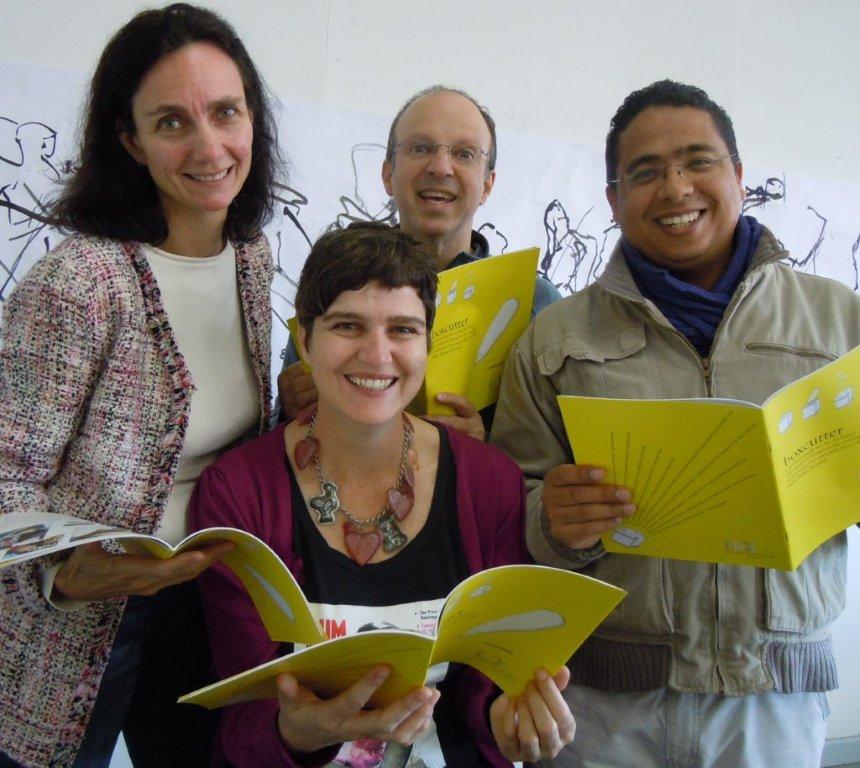
Book editor Janet Levy, creative facilitator Leonard Shapiro, Cape Craft & Design Institute business development facilitator Eugene Newman, and (front) author Karen Stewart, the CCDI creative workshop facilitator. Photographer: CCDI
Track Your Press Release HERE:
Check Online Visibility
Verify where this release is currently indexed:
 Jimmy Nevis and Friends live at The Boardwalk