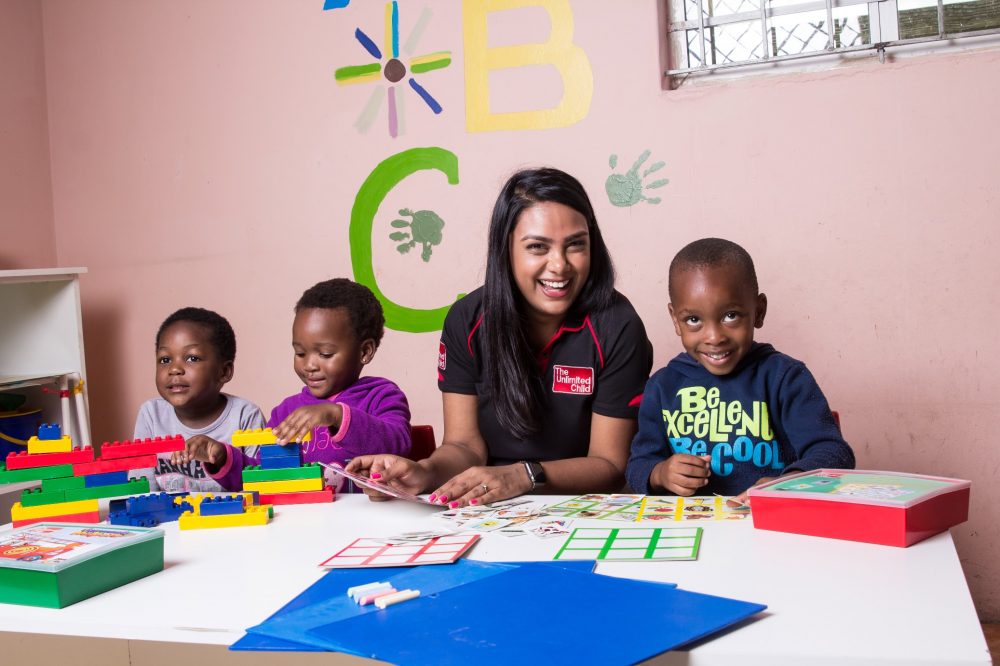

Education remains in the spotlight as more than a million Grade 1 learners starting their primary school journey at the beginning of the 2018 school year.
This comes in the wake of alarming concerns raised about the fact that although more than one million learners enrolled in Grade 1 in 2006, only an estimated 60% of these learners passed matric in 2017.
According to Candice Potgieter, CEO of one of the country’s leading early childhood development organisations The Unlimited Child, the fact that less than 50% of preschool children in South Africa currently have access to early childhood education (ECE) will have far-reaching implications for the entire education system.
“As we stand on the doorstep of another school year, it is an opportune time to reflect on the overall state of education in South Africa – and in particular early childhood education (ECD). Research has shown that children, who receive a good educational foundation between the ages of 0-6 years are more likely to succeed in school. However, about 60% of SA children begin life at a lower level of capacity than they should and increasingly fall behind during the most formative period of their life. The net effect is educational under-achievement, high rates of personal and social problems as well as poor prospects for growth, prosperity and social stability,” states Potgieter.
In 2017, the Progress in International Reading Literacy Study (PIRLS) showed that almost 80% of South African Grade 4 pupils fall below the lowest internationally recognised level of reading literacy in their language of learning and could not read with comprehension. This study exposed serious problems with teaching and learning in the pre-Grade R and the Foundation Phase.
According to Potgieter, investment in Early Childhood Development (ECD) is one of the most effective ways to decrease social inequalities in a country with high levels of poverty and large numbers of learners coming from disadvantaged backgrounds. Interventions aimed at improving early childhood development also have the ability to increase school attendance numbers and the pass rates of learners at primary and secondary school levels.
The Unlimited Child is having a profound impact on the lives of thousands of young South Africans through their early childhood education programme. Currently implemented in seven of the nine provinces, this integrated, rapid impact Early Childhood Education (ECE) stimulation programme equips practitioners in disadvantaged communities to use high quality training and resources. The programme is aligned with national and current policy standards and is available in English, isiZulu, isiXhosa, Sepedi and Afrikaans.
Launched in 2008 with the support of The Unlimited, a financial services company, by 2015 The Unlimited Child had reached 757 pre-school centres to provide access to quality educational programmes. During the past two years however, this non-profit organisation has shown meteoric expansion, scaling up to reach an additional 464 pre-schools.
To date, the organisation has trained 3673 pre-school teachers, provided educational toys and learning tools to 1221 pre-schools, reached 66411 children in pre-school centres and logged a cumulative enrolment of 201966 children. An independent M&E Research Study conducted by the University of KZN endorsed The Unlimited Child’s programme as a tried, tested and effective model with high impact and high quality.
“Early childhood education might seem like child’s play, but the impact of early childhood education on the life of a child is serious business. Learning through play with appropriate and quality resources has a profound effect on their formal education. Children who have been through our programme are more likely to succeed in school, embark on tertiary education, find a job and eventually make a positive contribution in creating the foundation for a prosperous society,” concludes Potgieter.
For more information please visit www.theunlimitedchild.org or follow The Unlimited Child on Twitter and Instagram @unlimitedchild and @theunlimitedchild on Facebook.
FOOT NOTE DEFINITIONS
• Early Childhood Development – a comprehensive approach to policies and programmes for children from 0-6 years, their parents and caregivers that support and promote the advancement of a child’s cognitive, social, emotional and physical development during this critical period
• Early Childhood Education – a component of ECD that includes learning programmes/activities designed specifically to stimulate the development of a child’s cognitive, social, emotional and physical skills
• An Early Childhood Development Programme – a programme, planned within an ECD service, which intends to provide learning and support suitable to a child’s level of development. It is a planned schedule of activities designed to promote development. Some people call this the Learning Programme or Curriculum. This means that a child’s age, stage of development and abilities must be considered when developing an ECD programme. Programmes may be offered at ECD centres or in other settings
• An Early Childhood Development Service – a service that intends to promote the development of children from birth to school-going age, regularly provided by a person who is not a child’s parent or pre-school teacher (ECD Practitioner). For example, an ECD service may be an ECD centre, cre?che, a pre-primary school, or a home-based intervention focused on the development of young children
CLICK HERE to submit your press release to MyPR.co.za.
Track Your Press Release HERE:
Check Online Visibility
Verify where this release is currently indexed: