

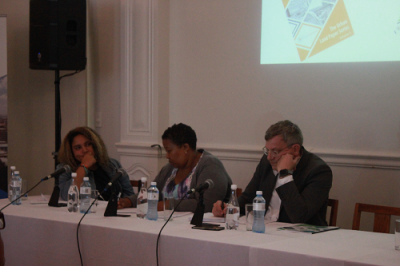
The last Urban Land Dialogue took place on 28 March 2018 in Cape Town. Informed by the Integrated Urban Development Framework (IUDF), which promotes an all-of-society approach to transforming South Africa’s cities and towns, the dialogues are organised in partnership with organisations that carry out urban land work and research, so that all-of-society voices are represented.
A general sentiment at the dialogue was that to have any hope of transforming the city will require new thinking and the embracing of unconventional ideas.
The “owners of money” must join the discussion: Referring to the inner-city gentrification that is happening in Cape Town, participants asked why the private sector cannot consider people and profit together. Housing should be viewed as homes, not commodities, and a system that forces people out of their homes and onto the streets is broken. In response, the private sector indicated that the “owners of money” – the financial institutions – set the terms and determine project parameters. The shared sentiment was that financial institutions need to be “in the room” and part of discussions about community issues.
Micro-developers are the future: Micro-developers collectively produce the most number of affordable housing units (for people earning between R2,000 and R10,000) in Cape Town. The UCT Urban Real Estate Research Unit found that in the Khayelitsha planning district alone, 6000 building applications were received, compared to just 4000 housing units being delivered in the conventional manner. The question was raised about how to support smaller developers operating in township areas. One idea was for the municipality to run “housing clinics” in these areas, thereby decentralising planning decision-making and making development applications easier for these enterprising developers.
Let’s move the economy to marginalised areas: As one private developer pointed out, the reality is that “we are doing business like we have for the last 300 years – all roads lead to the city centre”. For years, planners have been talking about developing the economy in townships and other decentralised nodes, but this requires a multi-sector response. Therefore, the private and public sectors need to seriously consider taking their operations into different areas. Clustering legal offices, financial firms and government offices in areas outside the city centre will demonstrate the development potential of these areas. In addition, a concerted effort is required to ensure greater inclusion, not only in housing but in every aspect of city life, which would be more likely using inclusionary zoning, not just inclusionary housing.
The three dialogues, in three provinces, highlighted the importance of enabling diverse voices to be heard. It is only through dialogue – sharing and listening to each other – that we will be able to build a collective view of the way forward, as required by the IUDF.
CLICK HERE to submit your press release to MyPR.co.za.
Track Your Press Release HERE:
Check Online Visibility
Verify where this release is currently indexed:
 Shell chooses Ricoh as its exclusive managed print services provider
