The World Public Relations Forum, the prestigious international bi-annual public relations and communications event, kicked off on Sunday 21 September, with the academic session inaugurated by Anne Gregory, president of the Global Alliance for Communication and Public Relations Management, Samuel Martín-Barbero, spokesperson for the Board of Dircom, and Karen Sanders, president of the Association of Political Communication and director of the Forums academic session.
Sundays session focused on contributions from the academic and university world. Professors and researchers from the field of communications from across the globe have discussed the different environments and facets involved in “Communication with conscience” at nine workshops/roundtables concentrating on specific themes in order to identify and analyze the challenges communication faces in the 21st century.
The plenary session on “What can professionals and students learn from one another?”, presided over by Ricardo Gómez Díez, associate professor at San Pablo CEU, and with the participation of Juan Carlos Molleda, professor and chair at the Department of Public Relations at the University of Florida, showed that communication with conscience is not only the theme of the World Forum but also the inspiration behind the work practitioners should undertake to benefit stakeholders in all companies and organizations. In the view of these experts, “research can only be validated externally through support from organizations in the industry. Nowadays an alliance with the profession is more critical than ever”.
Gregor Halff, president elect of the Global Alliance, led the plenary session, “Communication with conscience”, with emeritus professors Ray Hiebert, from the University of Maryland, and Robert Heath, from the University of Houston, as speakers. This session raised the idea of leadership as a concept that requires “engagement” from the whole organization and “the right to exercise your own conscience” was defended. Freedom of individual conscience, of expression and of faith”. The closing session focused on “Corporate social conscience in public relations” and was led by Judy VanSlyke Turk (Global Alliance), at which Sandra Duhé from the Southern Methodist University put forward the idea that “acting with conscience is doing things purposefully”.
The first official day of the 8th World Public Relations Forum (second day on the programme) focused on two of the four topics of discussion at the Forum, namely, deconstructing and transforming communication. Marisa Toro, director of communications and public affairs at Google Southern Europe, Antonin Léonard, blogger and founder of QuiShare, and Jerry Swerling, head of strategic communication and public relations at the University of California took part in the afternoon session, where they explained their views on how communication is transforming.
According to Marisa Toro, this process of change has been going on for the last 8 years but it has speeded up now and “we should take journalists along as travelling companions”. Marisa Toro pointed out that there are several important aspects to take into account in order for the communication professional to be successful: assessing how we consume news; how we present news and the channels used to spread news. “Its clear that the internet is here to stay and that, as professionals, we all need to incorporate this in our strategy. Happy incorporation”.
According to Antonin Léonard, the role of the collaborative economy has been a wake-up call for communications and traditional public relations practice. The internet era as a support to create your own news page has transformed thanks to communities on social media. “In the future there wont be any difference between what employees, users or customers say. Keeping alert, listening to customers honestly will help organizations fulfill their mission”. He also stressed that “companies cant control the message anymore”.
Jerry Swerling closed this session by unveiling the first GAP (Globally Accepted Practices) survey, conducted in 6 countries and focusing on globally accepted practices in the profession.
The afternoon finished after a discussion at the four parallel sessions, which covered areas such as reputation; corporate social responsibility; the new relationship between agency and client and measuring communication.
Summary of the mornings sessions:
Carmen Martínez Castro, the Spanish Secretary of State for Communications highlighted the importance of managing communication and closed her speech with a message of support to delegates: “I encourage this conference to come up with ideas and guidelines that can inspire us”.
José Manuel Velasco reflected on how the current system of organizations works; the power of conscience and importance of creativity. Daniel Tisch urged “professionals to collaborate internally and externally with organizations. We are promoting spaces for discussion that bring us closer to social justice. We have the opportunity and the duty to be the conscience of organizations”. Anne Gregory stressed the importance of leadership in public relations in order to “know how to interpret what is out there and bring it into organizations”. For Gregory, a communication professional should be the “manager of a social context”.
After the opening speeches, discussion began on how to “Approach the Global Agenda” in which Martina Larkin, Anthony Gooch; Peggy Liu and David del Val Latorre took part.
Martina Larkin analyzed the current economic trends and highlighted the three key aspects of a leader. Anthony Gooch emphasized the role of communication professionals: “We do not always have to be the protagonists of the communication process. We are the facilitators of this process”. Peggy Liu focused the discussion on the relationship between communication and the environment: “it is important to learn to create collaborative leadership”. David del Val Latorre closed the first panel by stating that “observing the behaviour of others is what makes ideas move forward”.
The last plenary session of the morning was led by Jovina Ang, founder and director of the communications consultancy Communicatio and former director of Marketing and Communication for Microsoft Services in Asia, who stated that: “while we make an effort to be professional, we also need to communicate with authenticity”. For Ang “there are 4 keys to success for an organization: strategy, people, communication and operational excellence”. José Antonio Llorente, founding partner and president of Llorente y Cuenca, highlighted “the importance of betting on notability rather than notoriety, a new concept of reputation”.
Carmen Martínez Castro, the Spanish Secretary of State for Communications, officially opened the second day of the 8th World Public Relations Forum at 10:00 and indicated the Spanish governments support for the industry in her opening speech.
The Secretary for Communications speech highlighted the major challenge we are facing in society at all levels, both socially and culturally, hence the importance of managing communication. She closed by transmitting a message of support to delegates: “I encourage this conference to come up with ideas and guidelines that can inspire us.”
José Manuel Velasco, president of Dircom, Anne Gregory, chair of the Global Alliance, and Daniel Tisch, former chair of the Global Alliance, also took part in the opening session and invited delegates to approach the global agenda from the point of view of conscience.
The first panel of experts, comprising Martina Larkin, Senior Director of the World Economic Forum; Anthony Gooch, Director of Public Affairs and Communications at the OECD; Peggy Liu, Chairperson of JUCCE –China, and David del Val Latorre, Chairman and CEO of Telefónica R&D, continued analyzing how to tackle the Global Agenda.
Key points made by speakers:
José Manuel Velasco began by reflecting on how the current system of organizations works; the power of conscience and importance of creativity. “A communication professional must act as a conductor and facilitate the process for them. It is not enough just to send the message; we must be a superconductor to facilitate information.”
Daniel Tisch included a note of warning to the media in his speech: “We need a fair and free press. This is a challenge of responsibility. The role the media plays should be linked to the role of the PR professional and we should break away from the traditional view of ‘making a noise. For Tisch, “professionals should collaborate internally and externally with organizations. We are promoting spaces for discussion that bring us closer to social justice. We have the opportunity and the duty to be the conscience of organizations.”
Anne Gregory, after expressing her concern about the current situation and crisis of confidence in all areas (business, politics, sport, etc.), stressed the importance of leadership in public relations in order to “know how to interpret what is out there and bring it into organizations.” For Gregory, a communication professional should be the “manager of a social context.”
After the opening speeches, discussion began on how to “Approach the Global Agenda”
In her speech, Martina Larkin highlighted the current economic trends and three key aspects of every leader. For Larkin “Each and every leader is responsible for knowing how to lead communication.”
Anthony Gooch emphasized the role of communication professionals: “We do not always have to be the protagonists of the communication process. We are the facilitators of this process.”
Peggy Liu focused the discussion on the relationship between communication and the environment: “it is important to learn to create collaborative leadership” and urges philanthropists and leaders to cooperate on climate change.
David del Val Latorre closed the first panel of the plenary session at 11:00 by stating that “observing the behaviour of others is what makes ideas move forward.”
The Spanish Prime Minister, Mariano Rajoy, took part in the third and last day of the WPRF and demonstrated his institutional support towards communication professionals while recognizing the constant changes the profession itself is having to undergo.
In addition he also expressed his gratitude towards the Global Alliance for choosing Spain and in particular Madrid as the host of this communications forum, Rajoy expressed that “no modern organization can afford to neglect its communication”. Furthermore, he reiterated that nowadays the “Spanish brand” is highly valued.
Paul Holmes, CEO of the Holmes Group, alongside Trevor Ncube, Vice-president of the Mail & Guardian Media Group in South Africa, where the stars of the session as they both shared they own particular vision on “leadership through communication”.
Paul Holmes highlighted leadership through action and how public relations have a consulting function inside organizations. For Holmes: “the PR product is ‘relationships and we must develop key tools that serve them, regardless of it being an advert, a website or any other platform”. He insisted on the importance of finding a metric that reformulates and serves to measure the impact communication has. Trevor Ncube on the other hand shared his vision on what the role of leaders should be regarding communication and through credible and valuable messages. “Its hard to understand how someone can be a leader without communicating correctly. Therefore, we must lead through effective communication. Its not so much about them being good public speakers as having a credible and authentic message”.
Communicating with conscience
Rob Flaherty, CEO at Ketchum, and John Gerzema, president and CEO at BAV Consulting, went into detail about the concept “communication with conscience”. For Flaherty “global social conscience is more than a brand, its what people truly think about you”. Gerzema on the other hand spoke about new metrics in communication and threw a challenge at professionals: “As practitioners we must make brands and companies contribute trust”.
The key challenges professionals face in the communications industry where bought to the table at the parallel sessions. Some of them were social business, in which the employee “takes social power over the organization”; the new mobile settings; social media and video games strategies that allow interaction with the public in a more social and bidirectional way.
Topics like the need to communicate with transparency, new trends like co-creations, the role of the profession in the economic recovery and the importance of media in the new social paradigm were also debated at the Forum.
The closing session of the Forum was distinctively gastronomic under the title “Brands with conscience”. Ignacio Moliner, Communications Director at BBVA, presented alongside Joan Roca their latest project in Latin America in which they invested in talent, authenticity and values by educating in cooking schools. Joan Roca stated: “We were interested from the very start in getting in touch with schools to make them a part of the project”.
Anne Gregory, Chair of the Global Alliance, and Gregor Halff, Chair elect, ended the Forum with some of the main conclusions of the Madrid mandate. Furthermore, during the same session the name of the next city to host the World Public Relations Forum 2016 was announced: Toronto, Canada.
The WPRF 2014 was organized by the Association of Communication Directors (Dircom), together with the Global Alliance for Public Relations and Communications Management, and discussed in Madrid the major trends and challenges the corporate communications industry faces worldwide.
Author: Victoria Medina from Ketchum.
More Info link: http://ketchum.com
Images: For high res version/s of One image/s please contact: Ketchum.
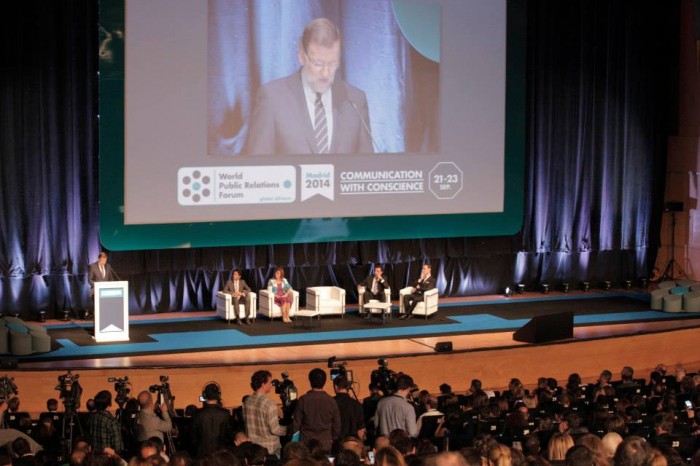
World Public Relations Forum Photo: WPRF
CLICK HERE to submit your press release to MyPR.co.za.
Track Your Press Release HERE:
Check Online Visibility
Verify where this release is currently indexed:
 Continued demand makes Douglasdale an investment hotspot