

RANCHO CUCAMONGA, Calif: From technology and manufacturing to healthcare, automotive and consumer goods, trade shows remain an important platform for businesses to introduce products, connect with potential customers and build industry relationships. As companies participate in events across the United States and international markets, choosing the right trade show booth has become an important part of their marketing and event planning strategies.
According to the Global Economic Impact of Exhibitions 2026 report by UFI and Oxford Economics, the global trade show industry recorded approximately 317.7 million visitors and 4.67 million exhibitors in 2025, generating an estimated €158 billion in direct spending. The report also recorded 138.1 million square meters of exhibition space sold worldwide.
With businesses from different industries participating in trade shows of varying sizes, there is no single booth format that works for every exhibitor. Display requirements depend on the products being presented, available floor space, target audiences and the overall objectives of each event.
Different Industries Have Different Trade Show Booth Requirements
For technology companies, a trade show booth often needs to accommodate product demonstrations, interactive presentations and areas for business discussions. Open layouts, integrated display walls and clear brand graphics can help visitors understand a company’s solutions while allowing staff to engage with potential customers.
Manufacturing and industrial exhibitors may have different priorities. Machinery, equipment samples and technical demonstrations often require more floor space, accessible product display areas and clearly defined visitor pathways. In these environments, booth layouts need to balance product visibility with practical movement and safety considerations.
Healthcare and pharmaceutical companies typically place greater emphasis on professional branding, clear information presentation and private discussion areas. Meanwhile, automotive and consumer goods brands may use larger visual backdrops, illuminated graphics and product-focused display areas to attract attention in busy convention centers.
These differences explain why trade show planning increasingly involves selecting a display format based on the intended application rather than simply choosing a standard booth size.
Non-Lit, Backlit and RGB Displays Offer Different Visual Options
One of the main decisions exhibitors face is whether to use a non-illuminated or illuminated display system.
Non-lit trade show displays are commonly used when businesses need a straightforward branded backdrop, product information area or meeting space. Printed fabric graphics and standard display walls provide a practical way to present logos, campaign messages and product imagery without integrated lighting.
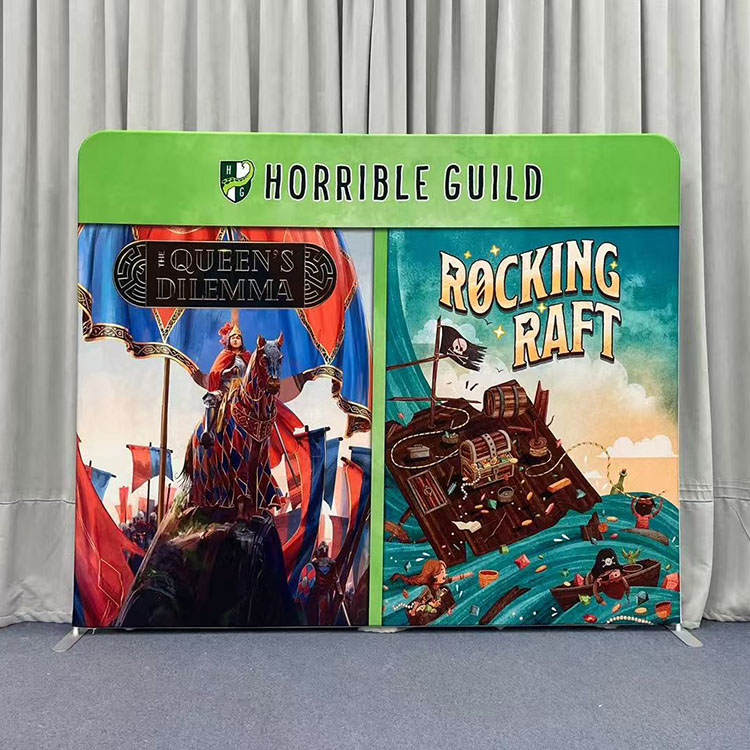
A tension fabric backdrop is one example of this approach. Printed fabric graphics fit onto a supporting frame to create a continuous visual surface. This format is suitable for trade show backwalls, promotional events, conferences and corporate presentations.
For exhibitors seeking greater visual visibility, backlit trade show displays offer another option. LED lighting positioned behind printed graphics illuminates the display surface, helping brand messages and images stand out in large convention centers where ambient lighting conditions can vary.
RGB LED displays introduce additional flexibility by allowing different lighting colors to be selected. This can be useful for technology presentations, product launches and branded environments where lighting is part of the overall booth design.
The choice between standard, backlit and RGB displays depends on the event environment, available electrical connections, graphic requirements and the type of audience a business wants to attract.
Modular Trade Show Booths Support Different Floor Plans
Booth dimensions and floor plans are another important consideration for businesses preparing for trade shows. A company attending a 10 × 10 ft event may require a compact backdrop and reception counter, while a 10 × 20 ft or 20 × 20 ft booth can accommodate more extensive product displays, meeting areas and storage.
Modular trade show display systems provide a way to adapt booth configurations to different space requirements. Rather than treating every event as a completely separate construction project, businesses can use reusable frame components, interchangeable graphics and different structural arrangements.
The wider range of trade show booth systems illustrates how booth structures can vary from compact portable displays to larger modular configurations.
Companies such as Frame Plus operate in the trade show display industry, with display formats covering illuminated and non-illuminated applications. The broader market includes portable backdrops, modular booth structures, SEG fabric displays, LED lightboxes and other display systems.
Reusability is also an important consideration for businesses participating in multiple trade shows each year. Retaining compatible frame components while updating printed graphics can help reduce the need to replace an entire display structure for every new campaign. Actual cost savings depend on transportation, storage, graphic replacement and component compatibility.
What Should Businesses Consider Before Choosing a Trade Show Display?
Although appearance is an important part of booth design, practical requirements should also influence the final decision.
Before selecting a display format, exhibitors should consider several factors:
- Booth size: Confirm the allocated floor space, height restrictions and access requirements.
- Marketing objectives: Determine whether the booth is primarily intended for product demonstrations, lead generation, meetings or brand awareness.
- Lighting requirements: Consider whether standard graphics are sufficient or whether backlit or RGB illumination would improve the presentation.
- Transportation and installation: Evaluate packed dimensions, component weight, setup requirements and available installation time.
- Future use: Consider whether the booth structure can be reconfigured or reused at other trade shows.
Convention center regulations should also be reviewed, particularly for electrical connections, suspended structures, fire-rated materials and installation procedures.
A More Purposeful Approach to Trade Show Booth Planning
The trade show industry serves businesses across a wide range of sectors, each with different requirements for presenting products and communicating with visitors. As companies continue to invest in trade show participation, booth planning remains an important part of preparing for these events.
Whether a business needs a simple non-lit backdrop, a modular trade show booth, an LED backlit display or an RGB lighting feature, the most suitable solution depends on available floor space, marketing objectives and practical event requirements.
A successful trade show booth is not necessarily the largest or most visually complex. It is one that communicates the business clearly, supports meaningful visitor interactions and makes effective use of the allocated space.
Boilerplate:
About Frame Plus
Frame Plus is a trade show display company based in Rancho Cucamonga, California, serving businesses across the United States and international markets. The company specializes in modular trade show booths, portable display systems, tension fabric backdrops, SEG fabric displays and LED lightbox solutions. Its product range includes both illuminated and non-illuminated display formats, supporting businesses across different industries with their trade show, conference and promotional event display requirements.
For more information, visit https://www.frame-plus.com/.
Media Contact Details:
| Frame Plus | |
|---|---|
| Joyce | |
| op02@frame-plus.com | |
| (840) 242-9099 | |
| https://www.frame-plus.com/ |
Submitted on 24/11/2026 by: Joyce Chen from Frame Plus.
Track Your Press Release HERE:
Check Online Visibility
Verify where this release is currently indexed:
 Giving the Guiding Hands a Hand: Supporting Teachers Is an Investment in the Future Prosperity of Our Country
