

Johannesburg:
CAG Executive Question of the Week
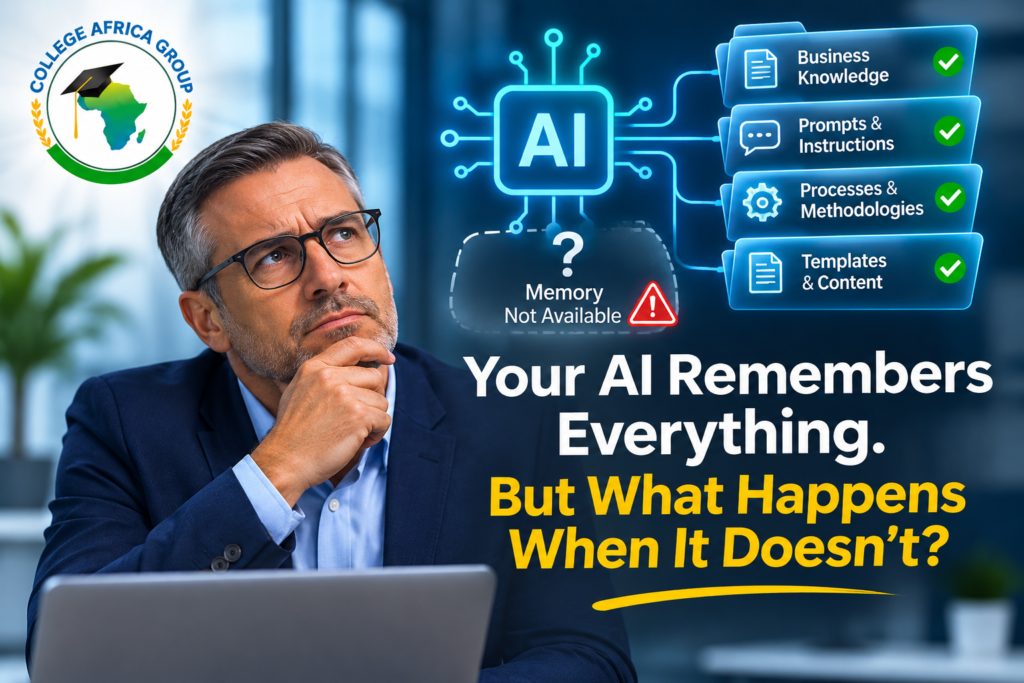
If your AI assistant forgot everything it had learned about your business, how long would it take your employees to restore that knowledge and return to their current productivity levels?
Artificial intelligence is becoming increasingly personalised. Employees are teaching AI platforms about their businesses, preferred working methods, customer requirements, corporate policies and operational processes.
Over time, these platforms can become valuable workplace assistants, drawing on previous conversations, stored instructions and business-specific information.
However, there is an important distinction that business leaders need to understand.
AI memory is not a corporate knowledge management system.
The Hidden Cost of Teaching AI Your Business
Consider a marketing manager who has spent twelve months working with an AI assistant.
During that period, the manager has developed:
- Corporate communication standards.
- Approved marketing messages.
- Customer profiles and preferences.
- Content development strategies.
- Reporting templates.
- Business-specific instructions.
- Quality control procedures.
The AI assistant becomes increasingly useful because it has access to relevant business context.
Now imagine that its memory becomes unavailable, previous conversations are lost, or changes to the platform affect how it retrieves information.
How much productive time would the manager spend rebuilding that working environment?
Multiply this challenge across finance, human resources, operations, sales and administration, and the potential business impact becomes considerably greater.
AI Memory Is Not Corporate Memory
Arnold Muscat, Director of College Africa Group (CAG), explains:
“Every time we teach AI something valuable about our business, we should ask ourselves whether that knowledge has also been captured somewhere within our organisation. AI memory is a convenience, not a business continuity strategy. The real value lies in the knowledge we develop, not simply in the technology that remembers it.”
Businesses should distinguish between temporary AI interactions and permanent corporate knowledge.
Not every conversation needs to be retained. However, valuable methodologies, approved processes, successful prompts and business decisions should be documented independently.
This is particularly important when employees leave an organisation or move into different roles.
Knowledge developed through AI should not become inaccessible simply because the employee who developed it is no longer available.
Stop Teaching AI the Same Things Repeatedly
One of the opportunities for improving AI productivity is reducing the time employees spend repeatedly explaining their business requirements.
College Africa Group has been developing a structured approach to preserving and reusing its corporate knowledge.
Instead of relying exclusively on AI memory, CAG maintains independent reference documents containing its:
- Corporate methodologies and intellectual property.
- Master prompts and operating instructions.
- Approved corporate messaging.
- Business productivity frameworks.
- Content development standards.
- Quality assurance and validation procedures.
These documents can be stored in a secure corporate folder using Microsoft SharePoint, OneDrive or another approved storage environment.
Where supported, different AI platforms can be directed to the relevant folder. Alternatively, the required documents can be uploaded directly.
The organisation retains its knowledge while maintaining the flexibility to work with ChatGPT, Microsoft Copilot, Claude, Google Gemini or other AI platforms.
Five Questions Every Executive Should Ask
Business leaders should consider the following:
- Where is the valuable knowledge developed through AI currently stored?
- Could another employee reproduce the same results using approved corporate documents?
- Are employees repeatedly teaching AI the same business requirements?
- Who is responsible for maintaining and updating corporate AI reference documents?
- Has the organisation tested whether its knowledge can be reused on another AI platform?
These questions should form part of a broader AI governance and business continuity strategy.
Access permissions, document version control, confidentiality, POPIA compliance and human validation must also be considered.
Measure the Productivity Opportunity
Consider an illustrative example involving 20 employees who each spend 15 minutes per working day repeating instructions or providing previously established business context to AI.
Based on 220 working days, this represents approximately 1,100 employee hours annually.
If a structured corporate knowledge repository could eliminate even part of this repetitive activity, the organisation could release valuable productive capacity.
The actual improvement should be measured rather than assumed.
The College Africa Group Perspective
Effective AI adoption is not simply about selecting the best AI platform or teaching employees how to write better prompts.
It requires organisations to examine their business processes, preserve valuable knowledge and establish sustainable working practices.
Through its AI Workflow Discovery services, College Africa Group helps businesses identify productivity opportunities, improve workplace processes and integrate artificial intelligence into their operations responsibly.
AI memory may improve. Technology will evolve. Employees will change roles.
Your business should never have to relearn what it already knows.
Images:
Video:
https://www.youtube.com/@collegeafricaexcelvideotip1434
Your AI Remembers Everything. But What Happens When It Doesn’t?
Links:
Boilerplate and Editor’s Notes.
More Info on Your AI Remembers Everything. But What Happens When It Doesn’t? here:
LinkedIn: https://www.linkedin.com/company/9491250/admin/dashboard/
Facebook: https://www.facebook.com/CollegeAfrica
Phone: +27 (0) 83 778 4903
Email sales@collegeafricagroup.com
CLICK HERE to submit your press release to MyPR.co.za.
Track Your Press Release HERE:
Check Online Visibility
Verify where this release is currently indexed:
 Johannesburg Chef Kagiso Mongale Publishes the Modern African Table
