
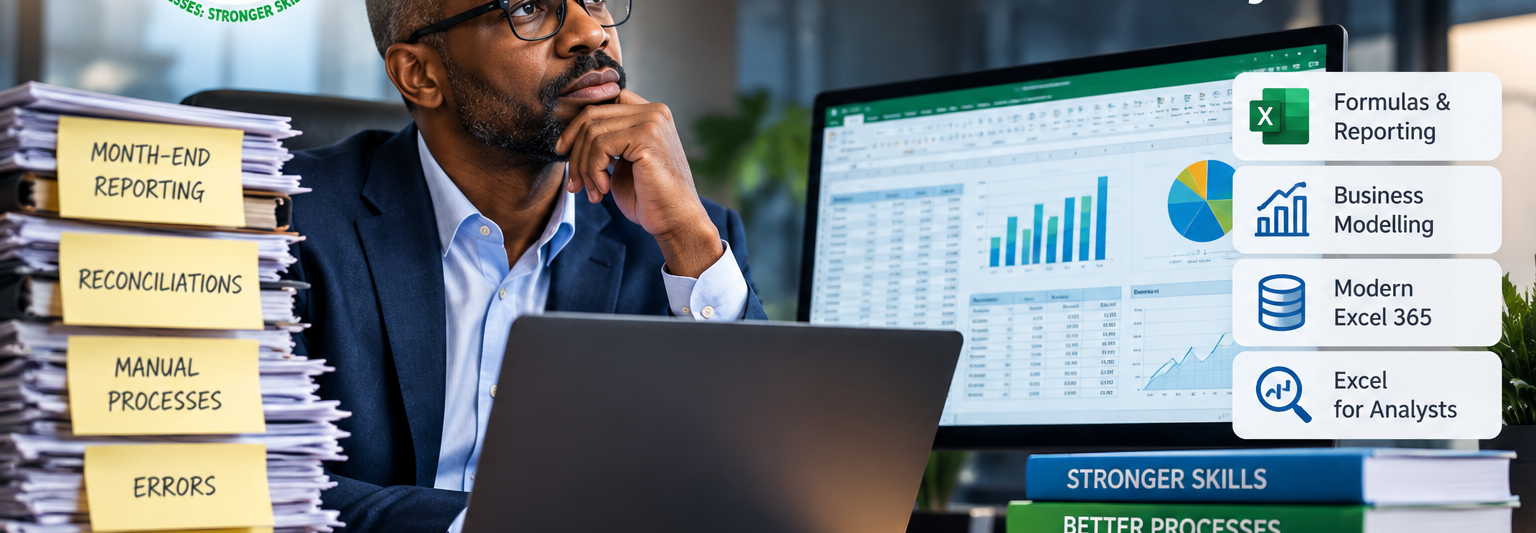
Johannesburg: Businesses continue to invest in Advanced Excel training courses, yet many employees still spend unnecessary hours preparing management reports, reconciling spreadsheets, correcting formulas and consolidating information.
The problem is not always a lack of training. Often, employees have been taught Excel functions without learning how to apply them effectively to the business processes they manage every day.
For CEOs, Finance Directors, Operations Managers and business owners, this raises an important question: Are employees developing the Excel skills the business actually needs, or simply attending another training course?
CAG Executive Question of the Week
If your employees have already attended Excel training, why are so many routine reports, reconciliations and spreadsheet processes still taking longer than necessary?
The answer may lie in how organisations identify training requirements.
The Problem: One Excel Course Does Not Fit Every Department
Excel is used throughout organisations, but its applications vary considerably.
Finance departments use spreadsheets for budgeting, financial analysis, reconciliations and management reporting. Operations teams monitor performance, consolidate data and identify operational problems.
Project managers use Excel to track expenditure, analyse resources and prepare forecasts, while sales managers examine revenue, margins and performance against targets.
These employees may all be classified as intermediate or advanced Excel users, yet their workplace requirements are very different.
Sending everyone on the same Advanced Excel course may improve their general knowledge without resolving the specific problems affecting productivity.
A finance manager struggling with financial modelling does not necessarily need the same training as an operations manager who spends hours manually consolidating monthly reports.
The business requirement should determine the training, not the course title.
Why Advanced Excel Skills Are Changing
Traditional Advanced Excel training has generally focused on formulas, lookups, PivotTables, data management and reporting.
These remain important workplace skills.
However, modern Microsoft Excel 365 also offers capabilities such as XLOOKUP, dynamic arrays and Power Query, which can help employees manage data and simplify repetitive processes.
Artificial intelligence introduces another consideration.
Microsoft Copilot and ChatGPT can assist employees with formulas, analysis and spreadsheet-related questions. However, employees still need sufficient Excel knowledge to understand the results, recognise errors and validate calculations against their original data.
An employee who cannot identify an incorrect formula may be equally unable to recognise an incorrect AI-generated formula.
Businesses therefore need a combination of strong foundational Excel skills, modern functionality and appropriate human validation.
The Solution: Match Advanced Excel Training to Business Processes
College Africa Group (CAG) has expanded its Advanced Excel training pathway to address different workplace requirements rather than treating advanced training as a single programme.
The pathway consists of four focused, one-day courses.
1. Advanced Excel — Formulas, Data & Reporting
Designed for employees who need stronger formula skills, more reliable data handling and improved reporting capabilities.
This provides an important foundation for staff working with recurring calculations, business data and management reports.
2. Advanced Excel — Business Modelling
Focuses on what-if analysis, XLOOKUP and business modelling techniques.
These capabilities are particularly relevant to finance managers, analysts and employees involved in budgeting, forecasting and evaluating alternative business scenarios.
3. Advanced Modern Excel 365
Introduces modern Excel capabilities, including dynamic arrays and Power Query.
The emphasis is on helping employees work more effectively with changing datasets and reduce unnecessary manual processing.
4. Excel for Analysts
Develops more sophisticated analysis capabilities using modern Excel functions and techniques.
This pathway is intended for employees who regularly work with complex datasets and need to produce meaningful business information.
The objective is not to send every employee through all four courses. It is to identify which skills will deliver the greatest benefit in their particular role.
Start With an Excel Skills Assessment
One of the challenges facing HR and departmental managers is determining employees’ actual Excel proficiency.
Employees frequently describe themselves as intermediate or advanced users, but these descriptions are subjective.
Someone who uses Excel every day may be highly experienced in a limited range of tasks while remaining unfamiliar with functions that could significantly improve their productivity.
CAG encourages organisations to assess practical Excel skills before selecting training.
An Excel Skills Assessment can help identify existing capabilities, knowledge gaps and suitable training starting points.
This approach can also prevent employees from being placed on courses that are either too basic or too advanced for their current abilities.
Measure Business Improvements, Not Just Training Attendance
Training success should not be measured solely by how many employees attended or whether they received a certificate.
Management should also consider what has changed in the workplace.
For example, can;
-
a monthly management report that previously required two days now be completed more efficiently?
-
finance employees reconcile information with fewer manual interventions?
-
Operations managers identify performance problems earlier?
-
analysts prepare more reliable information for management decisions?
-
employees independently validate spreadsheet calculations and AI-assisted outputs?
A useful starting point is to measure how long a recurring task currently takes, how frequently it is performed and how many employees are involved.
The same process can then be measured after training.
This helps organisations establish whether improved skills have released productive time, reduced errors or improved reporting quality.
Not every productivity improvement translates directly into a financial saving, but better use of employee time creates capacity for higher-value work.
The CAG Perspective: Better Processes Before More Technology
College Africa Group believes workplace productivity begins with understanding business objectives and the processes employees are expected to perform.
Training should then strengthen the skills required to execute those processes.
Microsoft 365 and artificial intelligence can support further improvements, but neither replaces the need for sound business practices or employees capable of validating their work.
For businesses investing in Advanced Excel training courses, the most valuable question is therefore not how many Excel functions employees will learn.
It is which business problems employees will be better equipped to solve after the training.
About College Africa Group
Established in 2003, College Africa Group provides practical corporate training and workplace productivity solutions to businesses across South Africa.
Its services include Microsoft Excel, Microsoft 365, Microsoft Project, Microsoft Copilot, ChatGPT for Business, AI Workflow Discovery and business productivity training.
CAG delivers instructor-led training through onsite and virtual programmes, with an emphasis on practical workplace application.
Better Processes. Stronger Skills. Smarter AI.
Find Out More
Businesses reviewing their employees’ Excel capabilities can explore CAG’s Advanced Excel training programmes and identify the most suitable learning pathway for their teams.
Advanced Excel Training South Africa: Explore CAG’s Advanced Excel training programmes
Excel Skills Assessment: Assess your employees’ Excel skills
College Africa Group: www.collegeafricagroup.com
Images:

Video:
https://www.youtube.com/@collegeafricaexcelvideotip1434
Are Your Employees Learning the Excel Skills Your Business Actually Needs?
Links:
Boilerplate and Editor’s Notes.
More Info on Are Your Employees Learning the Excel Skills Your Business Actually Needs? here:
X:
LinkedIn: https://www.linkedin.com/company/9491250/admin/dashboard/
Facebook: https://www.facebook.com/CollegeAfrica
Phone: +27 (0) 83 778 4903
Email sales@collegeafricagroup.com
CLICK HERE to submit your press release to MyPR.co.za.
Track Your Press Release HERE:
Check Online Visibility
Verify where this release is currently indexed:
 Matin Myers on the Show Business of Entertainment On Thursday Night 9PM