
- All Black v Stripy – let the games begin
- Aesthetics v Price – which do you choose?
In the Solar Industry there are two main choices when it comes to the Solar Panels you install on your roof – TOPcon or Back Contact.
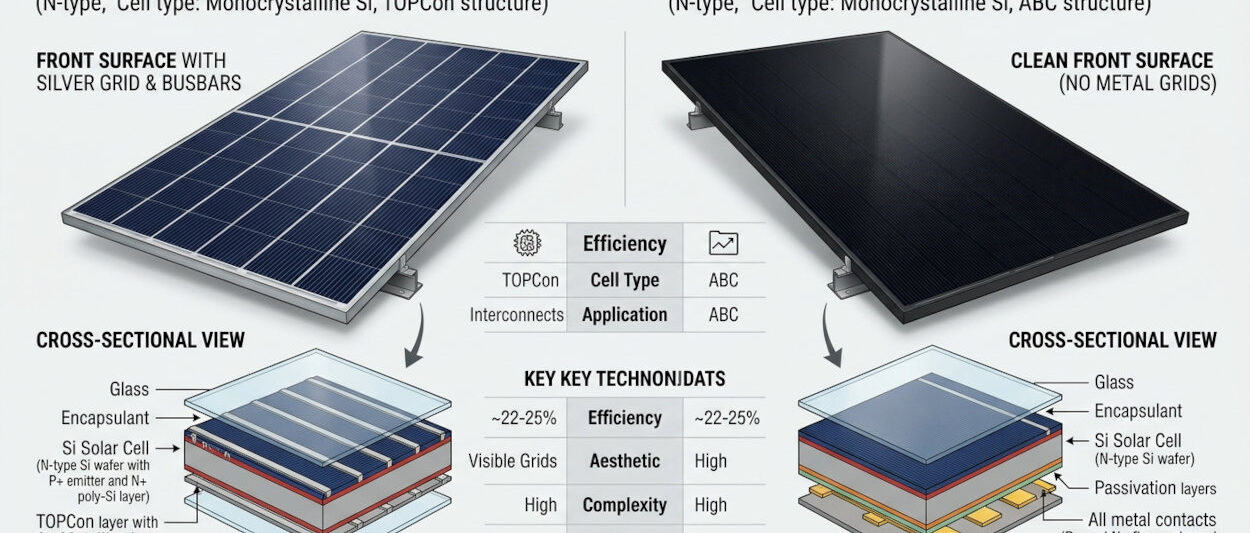
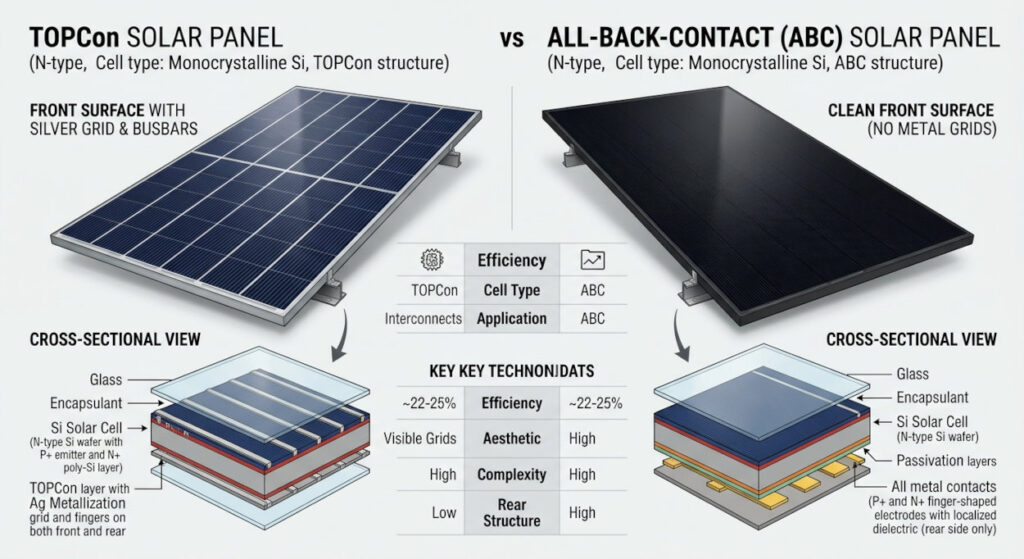
The essential difference between the two is that in the TOPcon panel the electrical conductors are visible on the top side of the panel – those thin reflective wires that you see forming a grid shape. Whilst the Back Contact solar panel moves all the conductors to the back of the panel – essentially leaving that good looking black face on top.
Moving the conductors represents an increase in area to produce electricity on the top but reduces the amount that can be reduced from reflective light from the bottom.
Major manufacturers still claim an increase in electricity generation of around 2% from the Back Contact panels over TOPcon.
But, the choice of which to use is still debatable – once widespread adoption of Back Contact occurs the prices will drop further and reasosn to switch to and specify Back Contact will become greater.
“At present we find clients seeking a better aesthetic for their homes choosing Back Contact over TOPcon,” explained Straton Solar.
TOPCon and Back Contact Defined:
TOPCon (Tunnel Oxide Passivated Contact): An advanced n-type cell technology where an ultra-thin silicon dioxide (tunnel oxide) layer and a poly-silicon layer are applied to the cell surfaces. While it vastly improves electron flow and reduces surface recombination losses compared to older PERC panels, metal contact grid lines (busbars and fingers) remain on the front face of the module.
Back Contact (BC): A general family of cell architectures—including IBC (Interdigitated Back Contact), HPBC (Hybrid Passivated Back Contact), and ABC (All Back Contact)—that relocates all positive and negative electrical contacts entirely to the rear of the cell. This leaves the front face 100% clear of any metal lines or grid layout.
Key Advantages of Back Contact (BC) over TOPCon
Maximum Surface Area Absorption & Higher Efficiency
Because there are no metal grid lines or busbars shading the front of a BC cell, 100% of the visible front surface is dedicated to capturing photons.
TOPCon commercial efficiency: Typically around 22.0% – 23.5%.
Back Contact commercial efficiency: Pushes 24.0% – 25.0%+ (with top-tier cells exceeding 27% in cell-level efficiency tests).
Impact: BC yields higher total wattage output per square meter, making it ideal for space-constrained rooftops.
Premium All-Black Aesthetics
Without metallic grid lines crisscrossing the front, BC modules deliver a sleek, uniform, obsidian-black appearance. For high-end residential and architectural solar designs, BC panels offer a clean, uninterrupted look that blends directly into modern roofs.
Superior Shading Performance & Internal Matrix Connections
In conventional TOPCon panels, shading a single cell row can trigger bypass diodes and shut down entire sub-strings, heavily reducing power output. BC cells often utilize interconnected multi-patterned rear contacts. This design allows power to flow around shaded areas across internal sub-circuits, resulting in noticeably less power drop during partial shading (such as from chimneys, trees, or debris).
Lower Thermal Stress & Hotspot Mitigation
Because all current dissipation occurs uniformly on the rear side without dense metal lines heating up the front face, BC panels experience lower localized heat accumulation. This significantly reduces the risk of destructive thermal “hotspots” and extends module structural durability over a 25- to 30-year operational life.
Better Temperature Coefficient
While both technologies leverage n-type advantages, top-tier Back Contact panels generally exhibit slightly superior temperature performance (around -0.26%/°C to -0.29%/°C) compared to standard TOPCon (around -0.30%/°C). This allows BC modules to retain slightly more of their rated output during extreme summer peak heat.
Where TOPCon Retains an Advantage
TOPCon still holds two major edges over BC:
Higher Bifaciality: TOPCon panels feature a high bifacial factor (~80%–85%), generating significant energy from ambient light reflecting off the ground onto the back side. BC panels have crowded rear contacts, which lowers their rear-side light absorption (bifacial factor ~70%).
Low-Light Irradiance Yield: TOPCon tends to maintain higher relative fill factors during very low-light conditions (early mornings, heavily overcast days).
Pricing Comparison
TOPCon is currently the high-volume, mainstream workhorse of the global solar industry, while BC is treated as a premium flagship design.
TOPCon Panels: Typically range from R1.65 to R2.64 per watt at wholesale/equipment costs (translating to roughly R13.21 to R19.81 per watt for residential installations before local incentives).
Back Contact Panels: Command a 15% to 30% price premium over TOPCon, costing around R2.31 to R3.63 per watt for raw hardware (translating to roughly R17.34 to R23.12+ per watt fully installed).
TOPCon remains the cost-efficiency champion for utility-scale solar and large commercial roofs. However, Back Contact is the clear choice for premium residential installations where maximizing power output per square meter, handling partial shade, and sleek architectural appearance matter most.
Images:
Links:
Boilerplate and Editor’s Notes.
More Info on TOPcon v Back Contact Solar Panels – Which is Better? here:
Facebook: https://www.facebook.com/StratonElectrical/
CLICK HERE to submit your press release to MyPR.co.za.
Track Your Press Release HERE:
Check Online Visibility
Verify where this release is currently indexed:
 Publicis Groupe Africa Opens Applications for Le Cubs 2027