
Johannesburg: The recent Microsoft 365 disruption has exposed an important business risk: organisations may own their information but still be unable to access it when the technology they depend on fails.
For many businesses, Microsoft 365 has become the backbone of daily operations. Outlook manages communication, Teams connects employees, OneDrive and SharePoint store information, while Microsoft Copilot and other artificial intelligence tools increasingly support reporting, analysis and decision-making.
When these services become unavailable, the consequences extend beyond technical inconvenience. Employees may struggle to communicate, access documents, retrieve important information or complete routine business processes.
The recent Microsoft 365 service disruption in November 2026 provided a timely reminder of how dependent organisations have become on interconnected cloud platforms.
But the bigger question is not whether Microsoft or another technology provider will experience another outage.
It is whether businesses have prepared for the possibility.
Who Really Controls Your Business Knowledge – You or Your Cloud Provider?
Businesses invest considerable time and money developing intellectual property, creating documents, building financial models, establishing procedures and generating valuable information.
Increasingly, employees also use ChatGPT, Microsoft Copilot and other AI platforms to develop reports, analyse data, draft proposals and improve workflows.
Yet much of this valuable knowledge remains inside individual applications, AI conversations or cloud storage environments.
Having information stored in the cloud does not necessarily mean a business can access it independently when those services become unavailable.
Arnold Muscat, Director of College Africa Group (CAG), believes businesses need to distinguish between using technology to improve productivity and becoming completely dependent on it.
“AI and cloud technology have made businesses more productive, but we must never lose control of our original information, intellectual property and the work we produce. If a platform becomes unavailable, employees should still have access to the information they need to continue working.”
The principle is straightforward: technology should support business operations, not become the only way those operations can function.
Your Business Knowledge Should Exist Beyond Your AI Platform
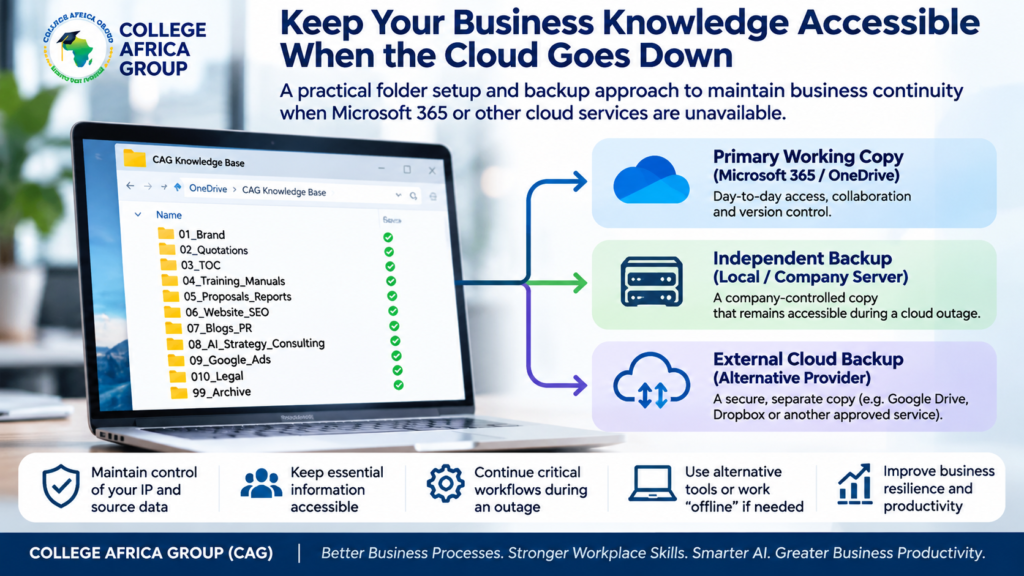
One practical safeguard is to maintain a structured company knowledge repository.
This should contain original source documents, business procedures, financial information, approved AI-generated outputs, templates and other important intellectual property.
Rather than leaving valuable work exclusively inside ChatGPT conversations, Copilot interactions or individual employee accounts, organisations should save approved outputs in clearly organised, company-controlled folders.
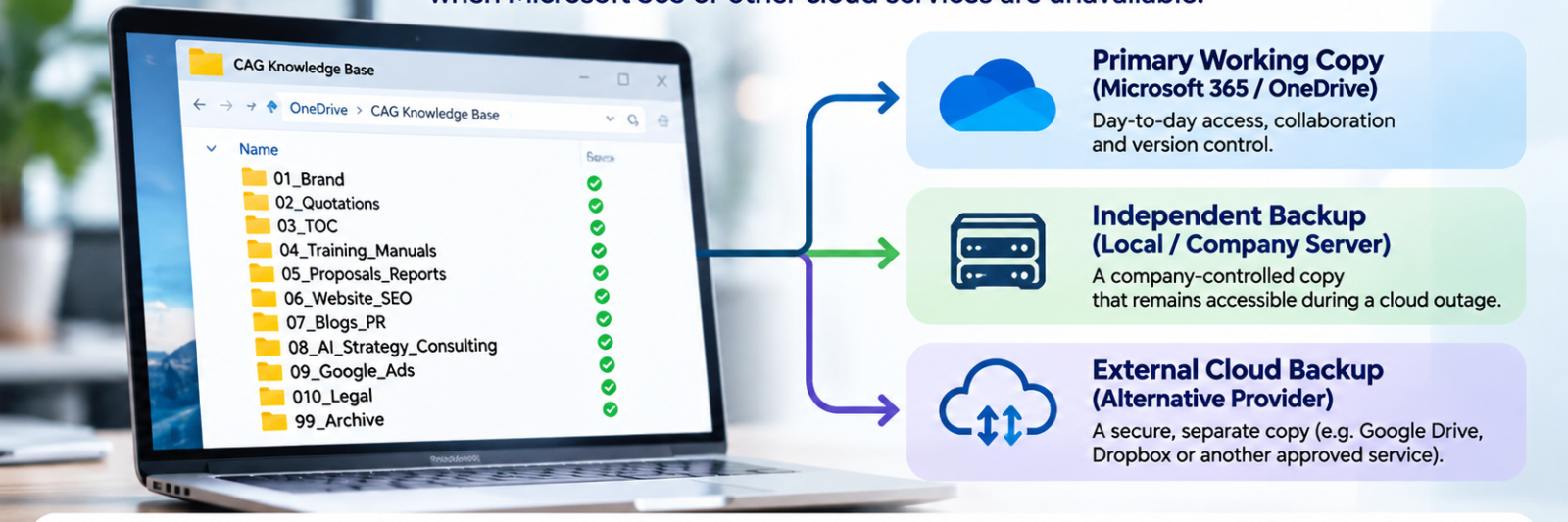
However, simply moving everything into OneDrive does not eliminate the risk. OneDrive is itself a Microsoft cloud service.
Businesses should therefore maintain independently accessible copies of essential information, whether through properly managed local storage, offline files, secure external backups or another suitable storage provider.
These copies must be protected through appropriate access controls, encryption and backup procedures.
The objective is not to duplicate every document unnecessarily. It is to ensure that the information required to continue critical operations remains available when the primary platform is not.
Could Your Employees Return to the Old-Fashioned Way of Working?
The recent disruption also highlights the importance of retaining practical workplace skills.
Employees who understand their business processes, can work confidently with Microsoft Excel and know how to prepare reports without AI assistance are better equipped to continue working when automated services fail.
A finance department, for example, should not become incapable of producing an essential report simply because its AI assistant is unavailable.
Where appropriate, employees could continue using locally accessible spreadsheets, previously downloaded documents and established manual procedures.
An organisation might also have an alternative approved AI platform available. If the necessary source information is accessible, employees could use that platform to assist with certain tasks.
However, alternative AI services must be evaluated for confidentiality, data protection and business suitability before sensitive information is transferred.
The important point is that employees must understand the work, not merely know which AI button to press.
Business Continuity Is a Management Responsibility
College Africa Group advocates a process-first approach to workplace productivity.
Before introducing AI or automation, businesses should understand their existing workflows, identify the information those workflows depend on and establish how essential activities will continue during a technology disruption.
A practical business continuity review should address five areas:
- Information ownership: Identify essential source data, intellectual property and approved AI-generated outputs.
- Independent accessibility: Maintain secure, tested copies of critical information outside the primary cloud dependency.
- Alternative workflows: Document how employees will continue essential tasks during an outage.
- Employee capability: Ensure staff retain the practical skills needed to work without AI assistance.
- Recovery and validation: Test backup restoration, information accuracy and the procedures required to resume normal operations.
These measures do not eliminate technology risk. They reduce the likelihood that a temporary service disruption becomes a complete operational shutdown.
The Real Measure of Business Productivity
The lesson from the Microsoft outage is not that businesses should stop using Microsoft 365, artificial intelligence or cloud services.
These technologies remain valuable tools for improving efficiency, collaboration and business productivity.
The lesson is that organisations should not allow convenience to replace operational resilience.
A business that saves hours through AI but cannot operate when its AI platform becomes unavailable has introduced a new dependency that management needs to understand.
As Muscat explains:
“Business productivity is not simply about doing things faster with technology. It is also about ensuring that employees have the information, skills and processes to keep working when technology is unavailable.”
A Practical Starting Point for South African Businesses
College Africa Group helps organisations examine existing workflows, identify productivity bottlenecks and determine where stronger workplace skills, Microsoft 365, automation or artificial intelligence can deliver measurable improvements.
Its AI Workflow Discovery approach begins with understanding how work is performed before recommending technology or training interventions.
For businesses reviewing their dependence on cloud services and AI, the starting point should be a simple assessment of which critical processes would stop if their primary technology platform became unavailable.
The executive question is no longer simply how much AI can improve productivity. It is whether the business can remain productive when AI or its supporting cloud services are unavailable.
Learn more: College Africa Group — AI Workflow Discovery
Contact: College Africa Group
College Africa Group (CAG) is a South African corporate training and business productivity consulting provider established in 2003, specialising in workplace skills, Microsoft 365, Microsoft Excel, AI adoption and business process improvement.
Images:
Video:
https://www.youtube.com/@collegeafricaexcelvideotip1434
What Happens to Your Business When the Cloud Goes Down?
Links:
Boilerplate and Editor’s Notes.
More Info on What Happens to Your Business When the Cloud Goes Down? here:
LinkedIn: https://www.linkedin.com/company/9491250/admin/dashboard/
Facebook: https://www.facebook.com/CollegeAfrica
Phone: +27 (0) 83 778 4903
Email sales@collegeafricagroup.com
CLICK HERE to submit your press release to MyPR.co.za.
Track Your Press Release HERE:
Check Online Visibility
Verify where this release is currently indexed:
 Cape Town Founder Opens Google Ads and SEO Learning Community on Skool
