
LGBTQI people face exclusion and discrimination in the workplace. People who are less advantaged socioeconomically are most at risk of poor treatment and marginalisation, and a different sexual and/or gender orientation to the majority exacerbates this. At the level of individual companies in South Africa, there is insufficient, if any, formal and specialised workplace support for LGBTQI people. Informally, some co-workers and employers do provide support and show acceptance in the workplace and don’t show favouritism according to sexual orientation and gender. However, overall, there is little effective support, and it is too easy for a recruiter or employer to simply ignore certain candidates who apply for work or promotion on the basis of demographic factors. There are at least two organisations making headway, however. The Shambhala Organisation promotes and supports LGBT business leaders specifically. Shambhala invests in LGBT owned and managed high-potential businesses. These investments are combined with mentorship and support towards meeting business objectives. We need dedicated business chambers for and active in the LGBTQI community. We need several focusing on each group because the issues faced by the various members in the community are not the same. Transgender people face a different fight in the workplace compared to people who are homo- or bisexual, for example. Nevertheless, it is great news that Africa’s first business network for LGBTI+ people was launched in 2016. The network has offices in Johannesburg and is called PLUS the LGBTI+ Business Network. It is an ‘African trust that advances equality and freedom in southern Africa, with a particular focus on sexual orientation and gender identity.’ PLUS champions, promotes, supports and empowers South African LGBTI+ business owners and entrepreneurs with opportunities for learning, networking and conducting business for prosperity. PLUS aims to redress structural and economic injustices of the …

Mina Guli More Than 1/3 of the Way Through Her Global Run
100 MARATHONS IN 100 DAYS: MINA GULI MORE THAN 1/3 OF THE WAY THROUGH HER GLOBAL RUN We are using water faster than it is able to be replenished; #RunningDry Campaign Raises Awareness, Urges Change December 6, 2018. On the 4th of November at the New York Marathon, international water advocate, Mina Guli, set out on the ambitious individual challenge of running 100 marathons in 100 days to highlight the global water crisis. Having already completed more than 30 of the 100 marathons, through the UK, France, Italy, Uzbekistan and India, Mina has experienced first-hand ‘choke points’ that are feeling the impact of the emerging global water crisis. Following her final run in India today in Mumbai, Mina now heads to Hong Kong and China. “My journey so far has allowed me to meet so many incredible people and to see the real effects that water shortages are already having on our world,” says Mina. “For many of us, we don’t have a real concept of where our water comes from. We simply turn on a tap and the water is there. To meet children as young as 3 years old walking more than 2km a day to collect water has given me a real appreciation of just how precious water really is.” Mina’s passion to change how people think about water and have a world where there is enough water for everyone forever is what keeps her going. She has been meeting with local water heroes within each of the regions she is visiting. These water heroes are people who are devoting their time and energy to making a difference to the global water crisis. “In the UK, for example, I was joined on one of my runs by Dr Liz Goodwin of the World Resource Institute. Liz ran12.3km with me to represent SDG 12.3 which is the sustainable consumption and production patterns,” says Mina. “I learnt from Liz that if we stopped all food wastage we would be able to save 18% of the world’s water, which is a staggering number if you consider that less than 1% of the earth's water is useable by plants, animals …
Track Your Press Release HERE:

Can We End Racism? What it Means to Conscientise
Can We End Racism? What it Means to Conscientise - By Devan Moonsamy CEO of The ICHAF Training Institute Conscientise is a somewhat new (1960s) and tricky-to-pronounce term, but the concept is a wonderful ally in the diversity process. Some pronounce the word as con-chi-en-chise; others say con-chen-tize. The latter seems to be the most common in South Africa and is the simplest. Never mind how you say it, though, so long as you get busy with it. A basic definition is that it is to make yourself and others aware of important social and political issues. Conscientising is ensuring everyone knows their rights and responsibilities, but it also includes those nuances and subtle understandings that are more difficult to put into a list of dos and don’ts. To illustrate what it means to be conscientised in the workplace, think of someone coming in late to work. How a manager approaches the problem should differ based on their (conscientised) understanding of the employee and their circumstances. For those who have no choice but to use public transport to get to work, particularly unreliable forms of transport, and especially on a day when there has been a strike, the response should be one of understanding and sympathy for the stress they are likely feeling. What about employees with very young children? How do they warrant special consideration at times? A conscientisied person is aware of these types of factors and their gravity, and will generally be better equipped to handle diversity and a variety of problems. In the workplace, conscientising is part of education, training and development. It is specifically identified as a precursor to the action of challenging inequalities in treatment and opportunities. People must know the power they have to do good and correct wrongs before they can achieve the ideals of equality and a non-racist society. Combating racism is thus about conscientising ourselves and others. Notions of race-based inferiority are combated …
Track Your Press Release HERE:

SPOT plays an integral role in “Lessons from the Edge”
In March this year South African ultra-runners, Ryan Sandes and Ryno Griesel, braved sub-zero temperatures, frost bite, exhaustion and starvation to set a new Great Himalaya Trail (GHT) FKT in a time of 24days 3hours 24min covering a staggering distance of 1504k. Joining Ryan and Ryno on their journey was a SPOT Gen 3 satellite tracking device, which proved an integral tool in not only their safety but also the filming of their documentary – Lessons from the Edge – by film maker Dean Leslie from Wandering Fever. “Logistically, this was one of the most complex shoots I have ever done. Having the SPOT tracking and being able to physically see the dot moving was integral to this trip. In fact I would be inclined to say that it would have been almost impossible to have documented their journey without SPOT!” says Dean Leslie from Wandering Fever. “When we had no comms for days on end it was our only source of “communication” with Ryan and Ryno. We were able to see from the live tracking exactly where they were and if they were safe or not, along with that we were also able to plan our weeks and gauge what sort of distances they were covering each day.” The film sees Sandes and Griesel traverse heavily snow-covered mountains and experience incredibly extreme weather conditions unusual for this time of the year along the way. They suffered frost-bitten fingers, serious tummy bugs, breathing difficulties and a couple of near death experiences. A constant on the route, however, was the incredibly welcoming spirit of the Nepalese people who truly embody the spirit of Namaste, and welcomed the both of them into their homes. “There was no way we could have attempted a challenge like this without SPOT and its tracking,” explains Ryno Griesel. “SPOT allowed us share our journey in real time with the rest of the world, logistically plan our routes and allowed us the confidence to push boundaries, knowing that help was always on hand!” Lessons from the Edge makes it …
Track Your Press Release HERE:
The future of work: Should Africa resist automation in the workplace?
The future of work: Should Africa resist automation in the workplace? By Devan Moonsamy CEO of The ICHAF Training Institute There has been a lot of buzz about the ‘future of work’ recently. There is major concern over who will become redundant and how this will happen – and rightly so. Wits recently conducted a review of research on the topic and found that most authors studying the issues are in fact negative or at least quite concerned about the impact of technology on employment prospects and society in general. People do benefit from various technologies. We have all experienced how they make our lives better in certain ways, for example, in healthcare. However, redundancy remains a major fear associated with the increased use of technology in the workplace. In Australia and the UK, for example, checkout staff at grocers and other major retailers have almost disappeared. Instead, checkouts at stores like Target (which is much like our Edgars) and Woolworths in Australia (similar to our shop of the same name, but a different company) are self-service. Petrol pumps are also self-service. If South Africa follows suit, this spells doom for many, many workers in these industries, and the majority of them are black and those most in need of employment opportunities. The Edcon group (which includes Edgars, CNA and Jet, among others) has about 39 000 employees, while the Shoprite group (Checkers, House and Home and others) has 147 000 employees, some of whom are in other African countries. We naturally feel afraid of the prospect of any of these people losing their jobs. We need many, many more jobs in South Africa. Fewer jobs is not a viable solution to our economic challenges, and so certain technologies can do more harm than good. If major retailers and petrol companies decide to go the automated checkout route in South Africa, we will likely have massive protests and even boycotts. We could expect that workers themselves – as well as customers – will …
Track Your Press Release HERE:

Ryan Sandes “Lessons From The Edge” Great Himalaya Trail to Premier at Ultra Trail Cape Town
Lessons from the Edge, a film documenting Ryan Sandes and Ryno Griesel’s epic adventures traversing the Great Himalaya Trail (GHT) earlier this year, will be premiering at the Ultra Trail Cape Town opening night on Thursday 29 November 2018. The film, shot by Dean Leslie and Jared Paisley from The Wandering Fever Productions for Red Bull Media House, captures the intricate stories within Ryan and Ryno’s successful 25 day 1500km Fastest Known Time (FKT) on the Great Himalaya Trail “Looking back on our GHT attempt, it is definitely one of the craziest projects I have attempted, and it was really awesome to have my close friend, Dean Lesley with Jared Paisley, along to document the journey,” says Ryan. “I’m really looking forward to the movie coming out, Dean has spent many months editing and crafting this story, so I am really excited to share it with everyone!” "Our Lessons from the Edge” project was one wild raw adventure,” exclaims Ryno Griesel. “It turned out a bit crazier and way more dangerous than expected and I am extremely grateful that I could share it with Ryan. It was definitely a life changing journey through massive mountain range and we got to meet amazing Nepali people along the way, but there were some dark times that we had to deal with ... we are excited to share this journey of our highs and lows with everyone!" The film sees Sandes and Griesel traverse heavily snow-covered mountains and experience incredibly extreme weather conditions unusual for that time of year along the way. They suffered frost-bitten fingers, serious tummy bugs, breathing difficulties and a few of near death experiences. A constant on the route, however, was the incredibly welcoming spirit of the Nepalese people who truly embody the spirit of Namaste, and welcomed the both of them into their homes. “Logistically, this was one of the most complex shoots I have ever done. The simplicity of Ryan and Ryno moving through the Himalayan Mountains on foot was seemingly …
Track Your Press Release HERE:
Is Diversity Receiving Enough Attention in Corporate Training?
Is Diversity Receiving Enough Attention in Corporate Training? By Devan Moonsamy CEO of The ICHAF Training Institute I’m proud to be the owner and CEO of the I Can Help Africa Foundation (ICHAF). We’ve been in the training business for over a decade, and I can look back on many challenges surmounted and successes achieved over the years. I always try to stay in touch with what our students and clients are saying and relate it to what I am doing. I pause to consider: Are ICHAF programmes making a difference and how big is that difference? Is it workplace-related or does it also lead to personal growth and the forging of good relationships in the context of diversity? Diversity is of critical concern to South African organisations. I wonder if even our entry-level qualifications make a difference in terms of diversity. Do ICHAF students feel their learning experiences are not only relevant to their jobs, but also offer some guidance on getting along with people who are different? Recently having co-authored a book about diversity and conducting diversity seminars as well as serving as a mediator in diversity-related conflict situations, diversity is constantly on my mind. I also recently had the opportunity to speak about immigration issues in the workplace – another important diversity variable in South Africa – on the etv Morning Show. So what have ICHAF students to say about the effect of our learning programmes on them? I was particularly interested in our entry-level programme, the NQF1 Business Practices course, which is a great way to get staff training started for just about any staff member. It is a year-long course, and there is a lot of focus therein on business skills like finance, computer use, customer care, etc. It is all very well having these skills, but if people can’t get along, we will never truly realise our goals, feel true fulfilment in our work, and make a difference in other people’s lives. I had to know what our students are …
Track Your Press Release HERE:
Toughest Skyrun Ever
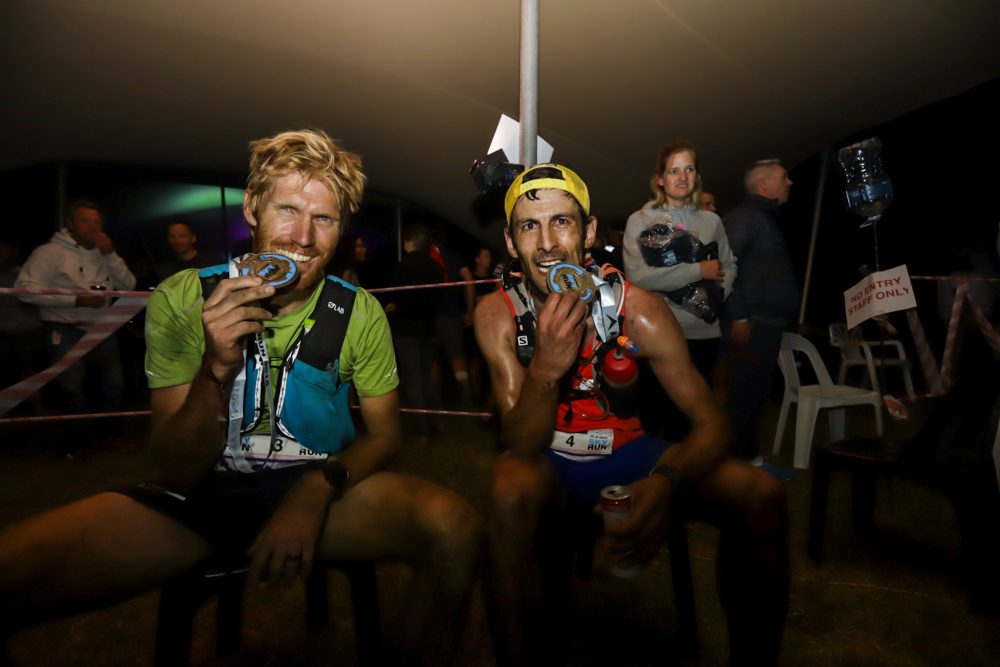
South African trail runner, AJ Calitz, has finally broken his K-WAY SkyRun curse, by taking the title crown on his 6th attempt in a time of 15hrs18min30sec. Following just over one minute behind AJ, the closest 2nd place in recent years, was recently crowned South African trail running champ, Stewart Chaperon in a time of 15hrs19min43sec, and local athlete Hylton Dunn in 3rd in 15hrs28min33sec. Nepalese runner, Sange Sherpa, took 4th place keeping alive the urban legend that no foreigner is able to take winning position at SkyRun. “That was a very hard race, it’s probably the worst I have ever felt whilst running,” says AJ Calitz. “But after Balloch I started feeling stronger and really believed that if I could just keep pushing I could do it! I am thrilled to finally have won this iconic race!” After a last minute decision to have to change the course route due to violent service delivery protesting in Lady Grey, the K-WAY SkyRun has proved that it can cope with anything thrown in its path, including the running of what many athletes are saying was a far more brutal course and temperatures reaching over 40 degrees. “In a year that has seen several of the country’s biggest ultra-endurance races cancelled for various reasons, we feel very proud that we were able to change the route and our start location less than 3 days before the start of the race and see some of the most incredibly nail-biting racing from our elite athletes,” says race organiser Mike de Haast from Pure Adventures. “In our 100km route the lead position changed more than 8 times throughout the race! We are thrilled that K-Way Athlete, AJ Calitz, took podium position in the first year that K-WAY has come on board as title sponsor!” In another race first, leading ladies Tracy Zunckel and Tarrin van Niekerk, who won the K-Way SkyRun 65km two years ago, finished in a tie in 20hrs46min04sec, followed by a tie for 3rd place some 5hrs later between Kate Birkett and Sofia Ackerman in …
Track Your Press Release HERE:

Timothy Becomes a Legend
South African ultra-endurance and marathon mountain biker and SPOT athlete, Timothy Hammond, will officially be crowned the first South African Epic Legend, when he completes the New Zealand Pioneer Mtb race later this month. “The reality that I could soon be South Africa’s first Epic Legend hasn’t really sunk in for me yet,” explains Timothy. “I lined up for the start of the FNB Wines2Whales at Lourensford last week for the first time since the ABSA Cape Epic used to finish there many years ago. Back then there was a small race on the last day of Epic called Vigne a Vigne. It was before I started racing seriously and can recall very clearly waiting for the leaders of the Epic to come in after our small race around Lourensford had finished. I remember being in complete awe of them and wondering if I would ever be capable, or get the chance to finish a Cape Epic one day. I stood there on the start of day 1 of W2W last week with 3 Cape Epics under the belt and on the verge of becoming the first South African to complete the series. I really had to calm myself down. Being able to ride the best trails in Switzerland, New Zealand and South Africa is a real blessing, too stoked!” Founder and CEO of the Epic Series, Kevin Vermaak says he feels very proud that Timothy will be the first South African to take this title. ““With the Epic Series, we’ve created a global community of like-minded athletes who want to challenge themselves and their teammates on the world’s most iconic mountain biking terrain. Any rider who has conquered the Swiss Alps, New Zealand’s backcountry wilderness or the untamed African Absa Cape Epic has passed the ultimate test of any mountain biker,” says Kevin. “To complete all three Epic Legend Races deserves the utmost respect of the mountain biking community and of course the coveted Epic Legend medal. It’s always a proud moment for me when a South African achieves something great. We are holding thumbs for Tim as he aims to complete the final …
Track Your Press Release HERE:

New champions to be crowned at the K-Way Skyrun 2018
A series of unfortunate injuries to leading trail runners this year means that new champions will be crowned at the 22nd running of the 2018 K-Way SkyRun taking place in Lady Grey on Saturday 17 November. K-Way athlete and defending champion Lucky Miya, who will not be able to fight for his crown in the 100km race, due to injuries during the year, will be welcoming in the 2018 champion before heading out on the inaugural 38km night run at this year’s event. “We are sad not to have our defending champs back to try reclaim their crowns, but it means that we have an exciting race on our hands for who will take the title this year,” says race organiser Mike de Haast from Pure Adventures. Leading contenders in the men’s race this year include K-Way athlete AJ Calitz, who has yet to add a SkyRun win to his list of achievements, along with Stewart Chaperon, who was crowned South African Ultra Trail Running Champion after his recent win at the Addo Elephant Trail. Also in the mix are SkyRun stalwarts, Hylton Dunn and Mr. SkyRun himself, Bruce Arnett, who has taken the title 13 times. The bug has bitten Nepalese mountain runner, Sange Sherpa, who will be back for his second year to race SkyRun after coming 2nd to Lucky Miya in 2017. There is a joke amongst mountain and trail runners that SkyRun has been bewitched by a foreigner curse, in the last 21 years of running this race, despite some of the very top names coming out to do it, it has never been won by a male foreigner, with overall first place always going to a local South African runner. Can Sange break the curse this year? And will this be the year that the elite men are able to break the Sub12 time barrier? Ryan Sandes was the first to run a sub14 in 2012, and this time has since only been achieved by a select few number of athletes, with none having yet gone under the 12 hour mark! In the ladies field, SPOT athlete Naomi Brand, who has been making a solid name for herself on the trail running scene is a …