

Targeted, trackable alerts on the employee screen deliver 90–95% policy completion in days — and the audit trail regulators now require. Johannesburg, South Africa: Organisations worldwide and across Africa are replacing email and Slack for critical compliance communications with direct-to-desktop pop-up alerts that appear in the employee’s line of sight, remain until acknowledged, and generate an attributable record of who saw which version and when. Emails get buried. Follow-up reminders pile up. Even then, large numbers of messages simply sit until forgotten. SnapComms research indicates only 19% of staff open compliance-related emails, with just 7% clicking through to the content. Average internal email open rates often fall to 20–45% for broad sends, and there is no reliable way to prove who actually engaged. Desktop pop-ups change the equation. Delivered directly onto the screen the employee is already using, they are hard to ignore. When used selectively for policy updates, security protocols, regulatory acknowledgements and other high-stakes items, they produce dramatically higher completion rates and a defensible audit trail. Why Email and Slack Fall Short for Compliance Email was never designed for mandatory, attributable delivery. Messages compete with newsletters, project updates and noise. Slack works well for team collaboration but lacks the forced visibility, mandatory acknowledgement and exportable proof required when an auditor asks for evidence. Both channels leave compliance teams chasing confirmations and reconstructing activity after the fact. Desktop platforms close that gap. Competitors such as SnapComms and DeskAlerts position pop-up alerts as the channel that bypasses the inbox, stays on screen until action is taken, and logs acknowledgement. SnapComms reports desktop alerts achieving high readership (one client recorded 80% message readership and up to 95% delivery for urgent IT communications) and claims the ability to drive toward …
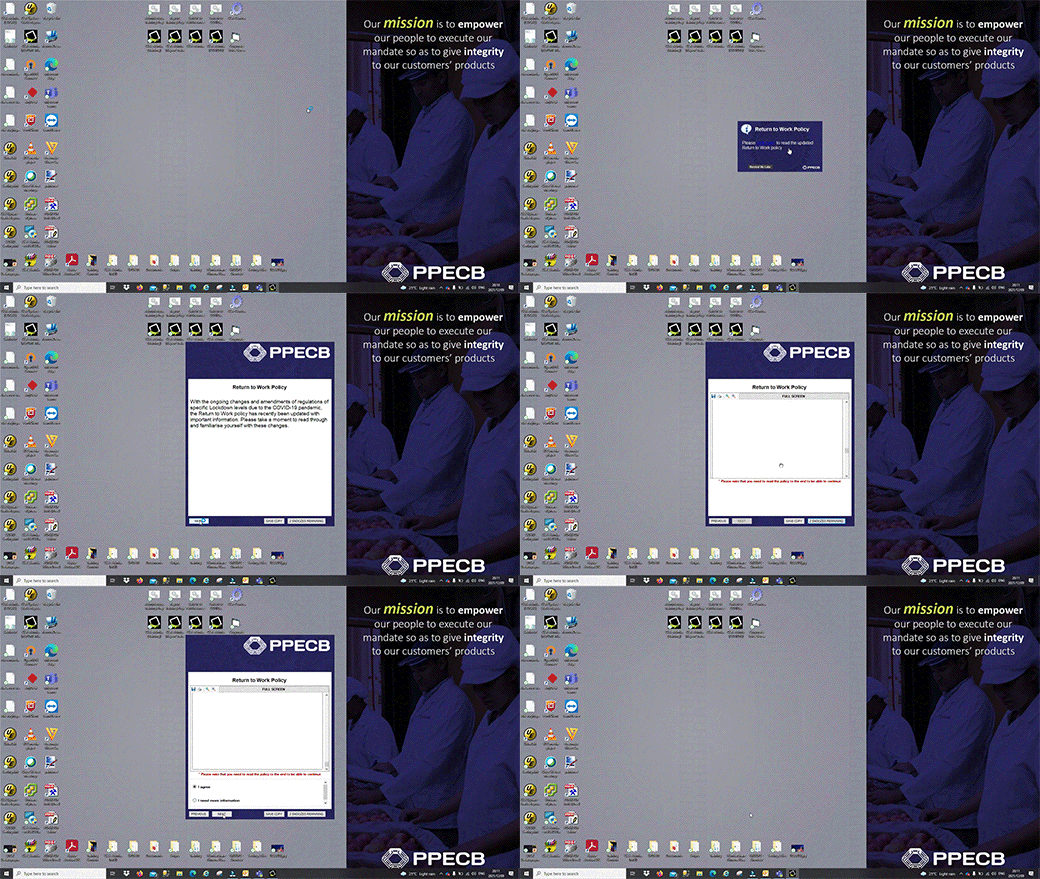
Corporate Voice Treats Policy Acknowledgement as Infrastructure as the Information Regulator Tightens POPIA Enforcement
Johannesburg, South Africa: Corporate Voice, the Johannesburg-based provider of desktop internal communications infrastructure, today set out why South African employers can no longer treat policy acknowledgement as an inbox task. The position follows a sharper enforcement year at the Information Regulator and is supported by a new operational briefing on what an audit trail for message acknowledgement must actually prove. POPIA does not ask whether a policy left the mail server. It asks whether the people bound by the rule were informed of the current version, and whether that fact can be produced. Most internal communications platforms still answer the first question and call it compliance. The enforcement climate has moved The Information Regulator’s 2024/25 annual report recorded 1,355 POPIA complaints, a 30 per cent increase on the prior year, and 2,374 security-compromise notifications, a 37 per cent increase. Five enforcement notices were issued in that year. At a 31 August 2026 briefing marking ten years since the Regulator was established, the largest POPIA fines disclosed to date were R5 million against the Department of Justice and R5 million against the Department of Basic Education. The Independent Electoral Commission paid R100,000. Amendment regulations published in April 2025 tightened administrative practice around consent and data-subject requests. Mandatory e-portal breach reporting has been in force since April 2025. New regulations on the processing of health information took effect in March 2026 and require employers to review the policies, contracts and acknowledgements that sit behind any occupational-health or absence process. The direction of travel is not ambiguous. The Regulator is no longer only writing guidance. It is issuing notices and fines. None of that enforcement is aimed at the quality of a newsletter. It is aimed at whether the responsible party can show that controls existed, that staff were informed, and that the …