
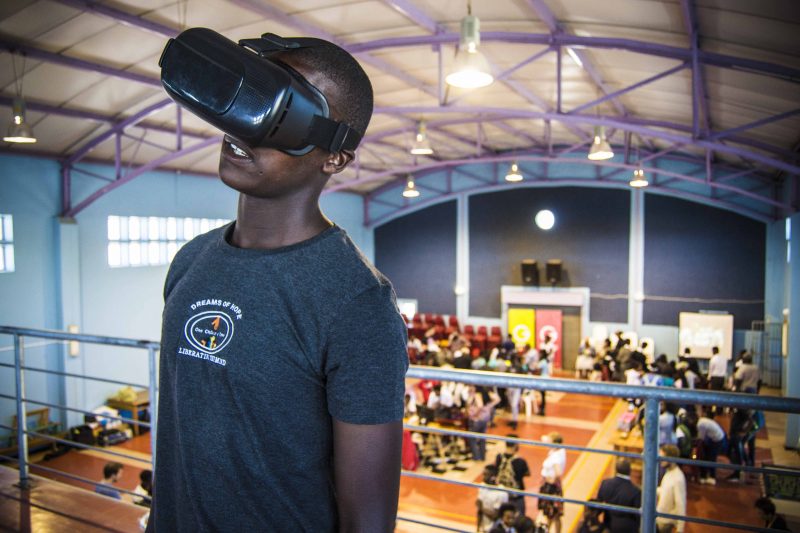
A young man discovers VR at a Serious About Games pop-up gaming event at Langa Sports Centre. Photo: Xola dos Santos A digital game competition is set to give Western Cape residents the opportunity to drive social change in their communities. “The Serious About Games initiative uses a new approach to address the challenges facing the province’s poorest residents,” said Alan Winde, Minister of Economic Opportunities. Four teams have been selected as semi-finalists and have been awarded R50 000 to develop the prototype of their game, which must be ready for final judging by 24 March. The project is a collaboration between the Western Cape Department of Economic Development and Tourism, the Cape Innovation and Technology Initiative (CiTi), Interactive Entertainment South Africa (IESA), 67 Games, and the Cape Craft and Design Institute (CCDI). Minister Winde said the Serious About Games initiative called for game developers to work with communities to create a game which would allow residents to reimagine their communities, with a focus on better access to economic opportunities. “We asked gamers to partner with community organisations to look at the biggest social and economic challenges caused by apartheid urban planning,” Minister Winde said. “The focus is on creating a platform for innovative community-sourced solutions to these problems. We also hope to foster a culture of innovation in our communities. As government, we are thinking of new ways to obtain data and trends we can use to make sure our projects are responsive to residents’ needs. “We’ve seen how the fourth industrial revolution continues to disrupt the economy, and it also presents alternative pathways to connect with citizens to improve government services,” said Minister Winde. Michelle Matthews, Head of Innovation at CiTi, said: “We are seeing a growing community of professionals from different backgrounds coming together to use games as a platform for education and learning across sectors, …

The Performing Arts network of Southern Africa is running a script writing workshop in Port Elizabeth
PORT ELIZABETH SCRIPT WRITING WORKSHOPS The Performing Arts network of Southern Africa (PANSA) is running a script writing workshop in Port Elizabeth on the weekend of 4 and 5 February 2017. While this is partly to help aspirant scriptwriters polish their plays for the 2017 Reading of New Writing Festival, a nationwide scriptwriting competition, the workshop is also open to anybody interesting in developing their talent as a scriptwriter. Workshop venue: Savoy Theatre & Conference Centre, conner Diaz Road & Stirk Road, Port Elizabeth. Times: 9:00 to 16:00. Refreshments and lunch provided. For more information, contact Margaret 074 918 6105. The workshop is free to paid-up members of PANSA. If you are not already a member, you will have a chance to complete a membership form at the door and pay the R150 annual subscription fee. For writers who do not want to join PANSA, the cost will be R400 for the workshop. For those who missed the original announcement of the 2017 Reading of New Writing Festival, this is a nationwide scriptwriting competition with cash prizes for regional winners, who will then go on to a national competition. The deadline for scripts is midnight 12 Feb. The reading of the plays of the shortlisted writers will take place over a weekend in four regions. The best script from each regional competition will go forward to the National final. The 2017 scriptwriting competition was made possible by a grant of R1.8 million from the National Lotteries Commission (NLC). Prizes and Awards: Regional competitions: Best writer R20 000 Runner up R10 000 Honourable mention R5 000 National competition: Best writer R20 000 Subsidy for full production of winning script R75 000 PANSA is a national network of performing arts practitioners, technical/stage workers, designers, administrators, educators, organisations, institutions and service providers. The organisation was established in June 2001 to unite the …
Track Your Press Release HERE:

Read aloud for literacy development this World Read Aloud Day
The national Nalíbali reading-for-enjoyment campaign is preparing to shatter its 2016 record and read aloud to at least half a million children across South Africa this World Read Aloud Day (WRAD), Thursday 16 February. The campaign, along with pledging partners including the Department of Basic Education (DBE); the Department of Social Development; LIMA; LIASA; Rotary; Volkswagen South Africa; The Bookery; and Zisize Ingwavuma Educational Trust, aims to raise awareness among adults and caregivers of the vital role of reading aloud in children’s literacy development by issuing a brand new story and calling on its friends, partners and members of the public to join them in reading it out loud to children on the same day. Last year, with the help of the nation, over 300 000 children heard a special story read to them in their own language and this year read-aloud sessions – big and small – are planned nationally. Some community reads will be led by Nali’bali, and others will be organised by members of the public with schools, libraries, fellow literacy organisations and non-profits joining in. Reading aloud is an important building block in children’s literacy development: it shows them how stories work; it teaches that reading and stories can be meaningful and satisfying; it offers an opportunity for adults and children to connect and get to know each other in relaxed ways, and, when read in home languages, it builds the foundations that children will need to learn a second language. This is particularly vital for school children making the transition from instruction in their home language to English in Grade 4. “Nal’ibali sees World Read Aloud Day as one of the most important events on our calendar,” says Jade Jacobsohn, Nal’ibali Managing Director. “Children who are immersed in great and well-told stories – in languages they understand – become inspired and are motivated to learn to read for themselves.” This year, Nal’ibali has commissioned award-winning …
Track Your Press Release HERE:

Extended deadline for script submissions
Scriptwriters will be pleased to hear that PANSA has extended the deadline for script submissions for the Festival of Reading of New Writing – the scriptwriting competition for new, emerging or experienced writers. The 2017 competition was made possible by a grant of R1.8 million from the National Lotteries Commission (NLC). The closing date for competition entries has been extended by two weeks to 12 Feb 2017. The competition is open to all South African based writers and the script must be an original work for stage, not previously produced in any form. The competition rules can be downloaded from www.pansa.org.za/competition The cut-off date for applications to attend the script writing workshops has also been extended. The deadline for workshop applications is now 23 January 2017. The workshops, designed to assist writers to develop and hone their craft, will run at the end of January 2017. If you are interested in attending the workshops, apply in writing before 23 Jan 2017. Workshop application forms are available from www.pansa.org.za/competition All scriptwriters are urged to read the competition rules carefully. Failure to abide by the rules may result in your entry being disqualified. Happy writing and good luck! Prizes and Awards: Regional competitions National competition Best writer - R20 000 Best writer - R20 000 Runner up - R10 000 Subsidy for full production of winning script -R75 000 Honourable mention - R5 000 CLICK HERE to submit your press release to MyPR.co.za. …
Track Your Press Release HERE:
UWC wins student supercomputer competition with “No Windows”
A team of young students from the University of the Western Cape proved their supercomputing skills when they won the annual Centre for High Power Computing (CHPC) South African Student Cluster Challenge last week (8 December 2016). The UWC Computer Science department collaborated with the South African National Biodiversity Institute (SANBI) and rose to the challenge to build the most powerful supercomputer within a designated budget. Using equipment sponsored by Dell, the ten teams from universities across South Africa competed over five days to run scientific computing benchmarks on the high performance computers that they designed and built themselves. Team members Liam Doult, Tyrone Ruiters, Kyle Jordaan and Mishka Mohammed are all second year B. Sc. Computer Science students. They chose the tongue-in-cheek (but quite accurate) name ‘No Windows’ and set out to fulfil any nerd’s dream of building a super computer. With dedicated support and advice from their mentor SANBI M.Sc. student Eugene de Beste (assisted by Warren Jacobus, also a Masters student at SANBI), the UWC team overcame all hurdles to emerge victorious. Things started with a twist: the equipment the students needed arrived late, only being delivered on Tuesday afternoon. After unboxing and setting up the servers the students had to work through the night to deploy their design onto the computer hardware and ensure that the scientific applications they were installing were running optimally. The Cluster Challenge is designed to give undergraduate students at South African universities exposure to the high power performance computing industry – an industry that's increasingly crucial to researchers in fields as disparate as astrophysics, molecular biology and even history, where there are complicated operations to perform on often massive datasets. Over the past few decades, computer clusters (two or more computers connected in such a way that they are able to act as a single …
Track Your Press Release HERE:

Exciting news for script writers!
The Performing Arts network of Southern Africa (PANSA) is pleased to announce the return of the Festival of Reading of New Writing – the scriptwriting competition for new, emerging or experienced writers. The 2017 competition was made possible by a grant of R1.8 million from the National Lotteries Commission (NLC). The competition is open to all South African based writers. The work must be an original script for stage, not previously produced in any shape or form. The competition rules can be downloaded from www.pansa.org.za/competition To assist writers to develop and hone their craft, PANSA will arrange and run scriptwriting workshops prior to the submission cut-off date for the competition. If you are interested in attending one of the workshops, planned for mid-January 2017, please apply in writing before 24 December 2016. Workshop application forms are available from: www.pansa.org.za/competition The submission deadline for finished scripts is the 31 January 2017. Successful regional candidates will be announced at the end of February 2017. The reading of the plays of the shortlisted writers will take place over one weekend in four regions. The best script from each regional competition will go forward to the National final. Prizes and Awards Regional competitions National competition Best writer R20 000 Best writer R20 000 Runner up R10 000 Subsidy for full production of winning script R75 000 Honourable mention R5 000 PANSA is a national network of performing arts practitioners, technical/stage workers, designers, administrators, educators, organisations, institutions and service providers. The organisation was established in June 2001 to unite the industry and work towards the collective interests of the performing arts community. As a member-driven organisation, we aim to build a growing and supportive audience for an inclusive and united Performing Arts industry …
Track Your Press Release HERE:
World Psychiatric Association’s International Congress in Cape Town – 18-22 November 2016: Setting a new course for Psychiatry in the community
The World Psychiatric Association (WPA) and the South African Society of Psychiatrists (SASOP) are hosting the WPA-International Congress in Cape Town, at the CTICC from 18-22 November 2016, with the theme: "Psychiatry: Integrative Care for the Community". The congress president will be Prof Dinesh Bhugra from the United Kingdom, current WPA President and the congress director will be the current SASOP President, Dr Mvuyiso Talatala. This is a ground breaking theme bringing together world renowned scientific experts, as well as young and established health leaders from around the globe. This is the first time ever a World Psychiatric Association International Congress is being held in South Africa. The conference is expected to attract over 3000 psychiatrists and other mental health professionals from around the world. With this meeting, the practice of Psychiatry internationally is set to take more decisive steps on a new course that will influence the profession for years to come. "This sounds like a very bold statement, but this is intended to be a very unique meeting," says Bernard Janse van Rensburg, President-Elect of the South African Society of Psychiatrists and co-chair of the organising committee. "We are hoping to see the forging of a strong link between society and Psychiatry and by the end of this year, we should see the basis of a new social contract involving all the different stake holders in this undertaking," he says. From the conference theme, the different components of Psychiatry's and psychiatrists' social contract will be unpacked, focusing on four different tracks including: neuroscience, psychotherapy, social involvement and the cultural-religious context of care. "There seems to be unfinished business in the psyche and national agendas of our (and other) nation(s)," says Janse van Rensburg. "We can see evidence of this in unresolved collective relations such as the recent flaring up of racial tensions in South Africa …
Track Your Press Release HERE:
The Double Burden of Malnutrition in a Globalised World
“South Africa is a country that suffers simultaneously from the problems of affluence and poverty, and both of these are a result of nutritional challenges that shape the world we live in.” So said health activist and researcher Prof David Sanders, speaking at the World Nutrition Congress 2016, hosted by the University of the Western Cape (UWC) from 30 August 2016 to 2 September 2016. Researchers, policymakers and advocates from around the globe took to the stage to discuss, debate and share insights on how to address “The Double Burden of Malnutrition In A Globalised World” - a world where some eat too little and some eat too much, and far too many eat in an unhealthy way, for a variety of reasons. It’s a world, as Sanders explained, where nutrition may be as big a challenge for society today as HIV/AIDS has been for the last 15 years. Obesity is increasing at alarming rates - and undernutrition remains at high levels, especially in Africa and South Asia. And given that South Africa has the highest rate of obesity in Africa (amongst the top 10 in the world), it is appropriate that the country won the bid to host this vitally important discussion - the second annual international convention of the World Public Health Nutrition Association (WPHNA). Participants from a variety of fields, ranging from land and agriculture to dietetics, health systems, economic and political studies, came together to address these issues. Prof Carlos Monteiro from the University of Sao Paulo, Brazil, delivered the keynote presentation of the Congress, Healthy diets must prevent all forms of malnutrition and promote sustainable food systems considers the impact of food systems on diet and nutrition, and discussed how Brazil (host of last year’s Congress) had successfully tackled child malnutrition. UWC’s Professor Ben Cousins, set the tone of the plenary theme, examining the impact of food systems on diet, nutrition and livelihood in his presentation, Cheap and nasty: …
Track Your Press Release HERE:
UWC’s world nuclear research success
The University of the Western Cape is flying the nuclear research flag for South Africa; it is the first African university to have an experiment approved to run at the prestigious European Centre of Nuclear Research (CERN), the holy grail for scientists worldwide. UWC has been allocated six days of experiments in November, which comes with a price tag of up to R2 million a day, to conduct groundbreaking research that will not only put the historically disadvantaged institution in the world spotlight, but also offer the local students involved the opportunity of a lifetime. It’s a dream come true for Nico Orce, professor of nuclear physics and nuclear astrophysics in UWC’s Department of Physics and Astronomy, who has spent the past four years chasing a chance for the university and his students to lead their own research at the biggest, most powerful laboratory created by humankind. CERN, which won the Nobel Prize for Physics this year, is based in Geneva (Switzerland). It has the world’s largest and most powerful particle collider, the so-called Large Hadron Collider which lies in a tunnel 27km in circumference, and employs 20 000 scientists and engineers. Although other South African universities, such at Wits, the University of Johannesburg and the University of Cape Town are strong collaborators at CERN, Orce said this was the first time an African university would actually lead an experiment there. The process began in 2012 when Orce first submitted their scientific case to CERN, but was told he needed a Letter of Clarification – which meant he first had to simulate the experiment here at home. “I spent a lot of time sleeping in my office at that time as I ran calculations over a long period of time. But I wrote the letter in September 2013, and it was approved.” The next hurdle was to tackle the Department of Science and Technology to ensure payment of fees equivalent to about R500 000 a year to allow UWC to schedule the experiment. But Orce explained …
Track Your Press Release HERE:
Prepare to reap the whirlwind: we’re facing a public health crisis ‘second to none’
Cape Town’s coffee culture has become an integral part not just of our city’s life, but also of the lives of starfish and filter-feeders living 40 m under the surface in Table Bay. A recent research project led by Professor Leslie Petrik, Leader of the Environmental and Nano Science Research Group in the Department of Chemistry at the University of the Western Cape, has found disturbing levels of caffeine in marine life. Professor Petrik led a research project to determine whether 12 known chemical compounds were present in our sea, and to what extent these chemicals were accumulating in our marine life. The Businesswomen’s Association of South Africa recently named Professor Petrik as the 2016 Businesswoman of the Year in the Science and Technology category. “Imagine taking a dose of painkiller, epilepsy medication, beta blockers, diuretics and thyroid treatments and some caffeine all at once, every day, in every glass of water you drink,” she said. “That is what we are subjecting these organisms to because our sewage systems are just not designed to remove the many chemicals that we use or consume in our daily lives.” “We know that in many of our coastal cities the sewerage effluent is directly released into the ocean, untreated. But the actual amount of chemicals which make their way into our seas is much higher than that because our standard sewage treatment is not designed to remove them.” Chemicals in daily use in most households, for instance in shampoo, toothpaste, washing powder and flea powder as well as medications and antiseptics all are passing through our water treatment systems and end up in our environment. “Products containing estrogen, such as birth control pills, can stop the proper development of male fish in the embryonic stage, with the result that with long term exposure to high enough concentrations an entire fish population can be wiped out within one generation,” she warned. Not all the chemicals are making their way …