
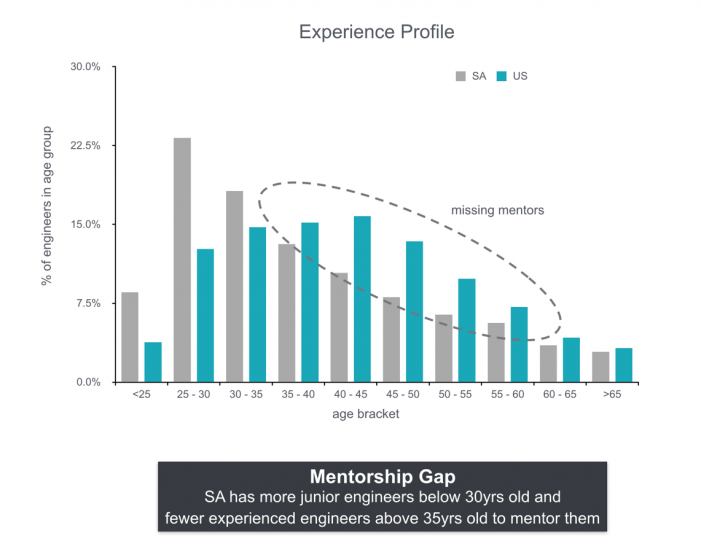
The engineering skills gap in South Africa is well documented, but what is not necessarily more widely understood is the loss of engineering professionals as a result of the bizarre way the industry has calculated fee income up until now. Simon Berry, director, Fresh Projects, an online business platform tailor made for South African built environment professionals, says that the industry has, for decades, been at the mercy of an imbalanced playing field with dire consequences: “Built Environment professionals have often under quoted on projects, offering unsustainable discounts, even as much as 70%, to get appointed. The knock-on effect of this is more serious than many realise. With a discount of that magnitude, Berry says that projects then have to try cover costs with as little as 30% of the fee that they should be earning, which is not feasible for any professional team: “This immediately impacts the earning potential for everyone and the long-term viability of a business.” ”In comparison, other professionals such as lawyers, accountants and doctors, charge hourly fees that fundamentally cover their costs, resulting in guaranteed profits for them. There is a disconnect between built environment fee guidelines and the real costs. The fee guidelines are based on value of construction works whereas the true cost to deliver the services is based on the number hours of professional input. So the issue lies in not knowing what the real cost is from the outset, according to Berry. These teams need a better understanding of the actual cost of a project, and how much leverage they have to offer discounts against tariffs, before it compromises the entire project and industry. “The sector has, and continues to, lose talent because the earning potential is reduced so significantly. Talented engineers are in great demand in other sectors and can earn more than what is being offered within the built environment sector, despite the skills shortage,” explains …

JCSE launches 2016 ICT skills survey
In its continuous effort to create a meaningful representation of South Africa’s ICT skills landscape, the Joburg Centre for Software Engineering (JCSE) at Wits University has launched its 2016 ICT Skills Survey. The 7th edition of the survey will aim to provide an outline of the current skills priorities and gaps in the South African ICT sector. The report is scheduled for release in May 2016. Adrian Schofield, Manager, Applied Research Unit, JCSE, says the previous editions of the survey were widely used by researchers and decision-makers seeking to understand the dynamics of talent supply: “The survey assisted in understanding the extremely complex environment of ICT extending from technology support to enterprise architecture, from data capture to cloud computing, from digital design to broadcasting.” Schofield says the 6th edition of the survey found that the state of the South African economy is depressing the demand for ICT skills as the sector’s clients cut back expenditures: “Although we have seen a global recession in the last few years, demand in Europe and the United States for ICT skills appears to be increasing or holding steady. South Africa is falling behind its peers in Africa (such as Kenya, Nigeria and Egypt) who are putting greater emphasis on the contribution that technology plays in economic growth.” He says that the JCSE continues to express its concern at the lack of improvement in South Africa’s basic education for the majority of pupils as well as the levels of transformation: “Exposure to, and familiarity with, ICT for all learners is essential to equip them to adapt the modern tools to their daily lives.” Trends in technology adoption place increasing emphasis on ICT sectors such as cloud; big data/analytics; mobile; security and the “Internet of Things”. Schofield says the ranking of the top five priority areas remained unchanged in 2014 from the previous survey. In descending order, they were Software as a Service/Cloud …
Track Your Press Release HERE:

Construction management methodology due for overhaul
The African property development industry is rich in new developments, pressured successes and epic challenges. Lessons can be learnt by examining these projects, their strengths and weaknesses, their management strategies, and the reasons for their success or failure. South African managing director of Onsite Control Systems, developers of a cloud-based collaboration system, John Haefele, believes that all projects have the potential for efficiency, effectiveness and cohesion, but unfortunately many projects conducted in today’s African environment are inherently inefficient. “Teams work ferociously against inherent problems to keep the project aligned, but due to the industry’s traditional methodologies and historically flawed tendencies, these issues prevail and the project is not always a success.” Haefele, who has 20 years’ experience in the African construction arena, says that the industry norm is anything but acceptable. He has played a direct role at varying disciplinary levels on many large-scale developments: “Diligent project teams and well-organised project managers do their best to tackle the challenges presented within the available systems and using traditional methods, but due to the lack of alternatives the results tend to be less than desirable. The reasons for any project’s failure are easily recognisable, definable, and can be overcome with the appropriate system and management mind-set change.” Redefining management processes “Traditionally, we built with a notepad, landline telephone, fax and a 2-way radio,” he says, but 20 years on and very little has changed. The fax evolved into uncontrollable and numerous emails; the landline has been replaced by the intrusive and contractually limited cell phone; while the trusty pocket notepad and 2-way radio still remain. Although these tools provide flexibility, it is the inherently flawed nature of this ‘toolset’ that results in the industry’s persistent challenges. “The multiple channels …
Track Your Press Release HERE:

Agilitude strengthens its Salesforce presence and offering in Africa
Africa’s leading Salesforce reseller and Consulting Partner, Agilitude has announced that it has completed the training for the newly launched Salesforce Lightning and is one of a limited number of partners worldwide that is Lightning ready. Quinton Pienaar, CEO, Agilitude says: “The future of CRM has changed with the launch of Salesforce Lightning and we are proud to be ready to deliver this newly upgraded CRM platform. The new version is not only more efficient and intelligent, but enables people to work faster, smarter and the way they want.” Built on the Salesforce1 platform, the new Lightning experience combines the Lightning Design System, Lightning App Builder and Lightning Components to enable anyone to quickly and easily create modern enterprise apps. “It delivers a new level of customer success and Agilitude is now able to deliver on the next generation of enterprise apps.” Lightning Experience offers a brand new, modern and intelligent experience across any device that enables users to work faster and smarter. Based on feedback from more than 150,000 customers, Salesforce Sales Cloud has been rebuilt from the ground up with Lightning Experience and more than 25 new innovations. Forbes.com in its ‘44 Facts Defining the Future of Customer Engagement’ said that according to a CEI Survey, 86% of buyers would pay more for better customer experience. “CRM is the new centre of gravity for businesses,” agrees Pienaar, “Companies of every size and industry are looking to transform how they work and engage with customers to drive growth, and they are turning to Salesforce to connect every interaction across sales, service, marketing, community, analytics and apps.” Agilitude has been a Salesforce reseller and Consulting Partner since 2013: “Since inception, we have spoken about the gap that exists between organisations and customers and that it has grown too wide. We believe in customer engagement and the role that technology can play in addressing …
Track Your Press Release HERE:

Teraco remains a hub for global players connecting to over 55 countries
Launched two years ago, the Africa Cloud eXchange (ACX) from Teraco Data Centre Environments now provides access to 54 African countries via local and global carriers. ACX aims to provide a secure data centre environment for cloud providers to colocate and onward distribute their service offerings to the rest of Africa. Through Africa’s largest internet exchange, NAPAfrica, global partners have access to key content from local and international content providers. With the deployment of a single cable within the data centre they can now distribute throughout Africa at low latency and high availability. Cloud services providers can also effectively share and sell cloud services to an extensive client base from a single distribution point within the data centre facility. “The tremendous growth that Teraco Data Centre Environments has experienced in the last year, makes it a true telecommunications hub and a low risk entry point into Africa,” says Lex van Wyk, CEO of Teraco Data Centre Environments. According to industry analyst reports, the ICT landscape in Africa is growing and there are a myriad of business opportunities for IT services. Key drivers for this growth includes major infrastructure projects, growth in financial services and an increase in governments’ spend on for example transport, infrastructure and citizen centric services. South Africa has also recently been ranked as a leading emerging economy on the African continent with the 15th largest telco market globally and the 2nd fastest growing cloud market in EMEA. “By nature, cloud providers are continuously exploring new markets for IT services and view an increase of their overall performance as a competitive advantage. For these companies it makes business sense to colocate at Teraco. We have a growing footprint, high network density and an excellent track record,” says Van Wyk. The philosophy of ACX is to enable colocation clients to share and interconnect with other cloud providers …
Track Your Press Release HERE:

NAPAfrica celebrates a new peak at 15Gbps
NAPAfrica, Africa’s most successful neutral peering exchange has reached a record-breaking peak of 15Gbps, making it the largest Internet Exchange Point (IXP) in Africa. NAPAfrica is housed within each of Teraco’s vendor neutral data centre facilities in sub-Saharan Africa. Michele McCann, business development manager for NAPAfrica says that the growth of this African IXP has been nothing short of phenomenal: “It was launched in March 2012, and by December 2013 traffic was peaking at 5Gbps. In a little over two years, NAPAfrica has outperformed other leading IXPs by achieving double-digit growth. This rapid adoption by the market proves that peering exchanges are a much needed facility in the African Internet ecosystem.” She says that peering in Africa not only makes the Internet more affordable, but that IXPs play a key role in advancing the development of the Internet ecosystem. “IXPs such as NAPAfrica help to deliver a lower cost and superior usage experience for the consumer, which in turn drives demand for the industry as a whole.” “Peering is not new,” reminds McCann. The practice of ISPs, backbone providers and content providers exchanging traffic directly - either for money or for free - has been in existence for many years. “This interconnection and exchange encourages the local routing of domestic or regional traffic and in doing so, reduces costs and improves performance. In reaching 15Gbps, NAPAfrica has just proven yet again that the IXP model works and makes a positive contribution to the Internet economy of Africa.” The role of the IXP in Africa will continue to grow in importance as the Internet increasingly globalises and interconnection between networks, content providers and users become even more critical: “Consumer demand for services with increased bandwidth requirements will continue to surge with lower tolerance levels for latency,” says McCann. The reason for the growth of IXPs such as NAPAfrica mirrors that of more developed …
Track Your Press Release HERE:

Fak’ugesi Digital Africa Festival announces Unyazi IV Electronic Music Festival
The highly anticipated Unyazi IV Electronic Music Festival will run from 9 to 13 September and promises to feature the latest and most innovative local and international talent in electronic music. Unyazi 2014 forms part of the Fak'ugesi: Digital Africa Festival hosted by Wits University, aimed at coordinating and curating a number of stand-alone conferences, exhibitions, workshops, short-courses and other activities that will promote the fusion of creative and technical development of digital culture in Africa. Cameron Harris, curator of the Unyazi event and lecturer in Composition and Music Theory at the University of the Witwatersrand in Johannesburg says Unyazi Festival of Electronic Music is one the very few African festivals dedicated to the latest developments in electronic and electro-acoustic music. “This year’s festival will feature innovative and experimental music from Africa and the rest of the world with a focus on collaboration between South East Asian and South African artists,” he says. The 2014 festival is set to emphasise the interaction between South African musicians and composers, and those from Asia including Tomoko Momiyama (Japan), Kazuhisa Uchihashi (Japan), Alfred Harth (South Korea/Germany), Carl Stone (Japan/US). Also performing are Ravish Momin (US) and Lukas Ligeti (Austria/US). South African artists who will be participating in the festival include Frank Mallows and Brydon Bolton. The South African New Music Ensemble will also perform at the festival. Festival goers can also look forward to a well-equipped listening room, set to be a focal talking and listening point of Unyazi IV. Explains Harris: “Featuring high-quality AV equipment and surround sound, the room will be both aurally and physically at the centre of activities, positioned equidistant from all the concert venues. During some periods of each day the room will function as a listening library where visitors can select from the large bank of music related to the …
Track Your Press Release HERE:

2014 ICT Skills Survey Presents Opportunity for Industry
The 2014 annual ICT Skills Survey, which officially kicked off in June is continuing apace as ICT practitioners and employers are encouraged to take part in the 6th edition of this highly-regarded evaluation of skills requirements and skills acquisition in the ICT sector in South Africa. The Joburg Centre for Software Engineering (JCSE) – a University of Witwatersrand partnership with government and industry – in conjunction with ITWeb and with the support of the Institute of Information Technology Professionals SA, the Information Technology Association and Eduflex's Virtual Assessor survey application, aim to ensure this year’s survey is the most comprehensive to date. In order to guarantee the continued success of the Skills Survey, manager of the JCSE’s Applied Research Unit, Adrian Schofield calls on more industry players to participate in the survey and contribute to helping policy and decision-makers who are working to close the skills gap in SA. “The debate around the skills needed to create, implement, support and use ICTs is global and perennial. Innovation and commoditisation of technology and the consumerisation and proliferation of devices ensure that the employers and practitioners in the sector must invest in skills and skills updates on a continuous basis,” says Schofield. Concerns around South Africa’s ICT skills shortage are not new and Schofield maintains that participation in this year’s Skills Survey is a fitting opportunity for the industry to help address the challenges facing the sector. In 2012, the United Nations Conference on Trade & Development and Innovation Report identified South Africa as a source of high technology for other developing economies. However, data also showed South Africa to be falling behind its peers in the percentage that technology represents of total exports. The report attributed undeveloped skills as a major reason for the disparity. Schofield explains that the ICT sector currently grapples with …