

As we approach April 1, 2026, the South African energy landscape is shifting from "concerning" to what many experts are calling a "national disaster." With the single largest fuel price hike in history hitting next week—pushing Petrol toward R26.00/L and Diesel to a record-breaking R30.00/L—the math behind the internal combustion engine (ICE) simply no longer adds up. For this exercise we used NMB Municipality's highest electricity tariffs to prove that EVs are still 60% cheaper to run than petrol. In the Nelson Mandela Bay Municipality (NMBM), we operate on an Inclining Block Tariff (IBT). This means the more you use, the more you pay per unit. For this comparison, we are assuming you are already a high-energy household (using over 500 kWh/month) and charging your EV entirely at the most expensive rate. What It Costs to Drive 100km in March 2026 With the massive fuel hike hitting on April 1st, we’ve run the numbers using the highest Inclining Block Tariff (IBT) in Gqeberha (R3.98/kWh). Even at this "worst-case" rate, the ICE engine loses. Vehicle Type Consumption Cost per 100km Petrol (95 ULP) 8.5L / 100km R219.30 Diesel (50ppm) 6.5L / 100km R191.75 Electric (Grid-Max) 18kWh / 100km R71.64 Electric (Solar) 18kWh / 100km R0.00 Even on the most expensive municipal electricity, you are saving R147 per 100km compared to petrol. For a daily commuter, that’s over R3,000 a month back in your pocket. The Solar Multiplier (Straton Solar’s Secret Sauce): The ultimate "hidden" saving is the ability to de-link your transport costs from the global oil market entirely. The Saving: You cannot refine your own petrol in your backyard BUT You can harvest your own electricity. The EV Charger Reality: For homeowners with a Straton Solar and EV Charger installations, an EV becomes a "rolling battery." By charging during peak sunlight hours, your 5-year "fuel" cost can drop from R250,000 (average for a high-mileage ICE) to …
Part Three: Pro EV Charger vs. “Granny Cable”: Why Go Dedicated?
Don't settle for slow EV charging. Learn why a dedicated wallbox is safer, faster, and smarter for your home. Stop Filling Your Tank with a Garden Hose Most EVs come with a portable "granny cable." While handy for emergencies, relying on it daily is like trying to fill a swimming pool with a garden hose. The Math of Speed A standard 60kWh battery takes: 26 Hours on a standard 3-pin plug (2.3kW). ~8 Hours on a Straton-installed 7kW Wallbox. Speed & Efficiency: A standard 2.3kW portable cable can take 20+ hours to charge a 60kWh battery. A 7kW or 22kW dedicated charger from Straton cuts that to a fraction of the time. Safety First: Dedicated chargers are designed to handle high current for long durations. Using a standard 3-pin plug for years can lead to socket melt or wiring degradation in older homes. Smart Energy Management: Modern chargers (like those Straton installs) can be integrated with your home’s solar and battery systems to ensure you are "charging with the sun," essentially driving for free. Why a Pro Installation Matters: Safety: Standard sockets aren't designed for 10+ hours of high-current draw. A dedicated circuit prevents melted wiring and fire risks. Intelligence: Smart chargers can "talk" to your solar system, ensuring you charge only when the sun is shining. Protection: Professional installs include surge protection to keep your R1-million investment safe from grid spikes. By utilizing Smart Home automation (With Shelly gear), you can: Load Shift: Ensure the car only charges when other heavy appliances are off to stay within lower tiers if possible. Solar Integration: If you’re pushing solar into the mix, your "fuel" cost can drop to effectively R0.00. Standard South African 3-pin domestic sockets are designed for intermittent loads (like a kettle or a vacuum cleaner). They are not built to handle a continuous high-current draw for 10 to 15 hours straight. Sustained charging at 10A or higher can cause …
Track Your Press Release HERE:
Part Two: The 5-Year Horizon: Are EVs Really More Economical?
Join Straton Electrical as we look past the sticker price to the "Hidden Savings" that make EVs significantly cheaper over a 5-year ownership period. The Hidden Savings: The True Cost of Ownership When comparing an EV to a petrol car, most people only look at the purchase price. But the real story is told over five years of ownership. While the "sticker shock" might be higher, the Total Cost of Ownership (TCO) tells a different story. Where do the savings hide? Zero Oil Changes: No spark plugs, no timing belts, and no exhaust systems to rust or replace. Brake Longevity: Thanks to regenerative braking, EV brake pads can last up to 100,000 km because the motor does the heavy lifting of slowing the car down. Efficiency: Petrol engines waste 70% of their energy as heat. EVs are 90% efficient, meaning almost every cent you spend on "fuel" actually moves the wheels. Total Cost of Ownership Maintenance Savings: Over 5 years, an EV requires no oil changes, spark plugs, timing belts, or exhaust system repairs. Brake pads also last longer due to regenerative braking. Residual Value: As petrol becomes a "luxury" and global demand for ICE vehicles drops, the resale value of EVs is projected to hold steadier than traditional cars. The Breakeven Point: Current 2026 data suggests that for a high-mileage driver, the higher upfront cost of an EV is recouped through fuel and maintenance savings within 3.5 to 4 years. Over five years, a high-mileage driver in the Eastern Cape can expect to save upwards of R200,000 in operating expenses alone. The Solar Multiplier (Straton Solar’s Secret Sauce): The ultimate "hidden" saving is the ability to de-link your transport costs from the global oil market entirely. The Saving: You cannot refine your own petrol in your backyard BUT You can harvest your own electricity. The EV Charger Reality: For homeowners with a Straton Solar and EV Charger installations, an EV becomes a "rolling battery." By charging during peak …
Track Your Press Release HERE:
Part One: The Great Transition: Why Electric Vehicles?
In this 6 part series we will explore why Gqeberha is at the heart of the EV revolution and how moving to an electric vehicle is about more than just the environment. The Future is Electric (and it’s being built in Gqeberha). The conversation around Electric Vehicles (EVs) has shifted. It is no longer a "someday" technology for early adopters; it is a "right now" solution for a world facing a perfect storm of energy costs. In the Eastern Cape, this transition is personal. With local automotive giants pivoting toward EV and Hybrid production, the vehicles of tomorrow are being built in our own backyard. But why should you make the switch? Mechanical Simplicity: A standard petrol engine has about 2,000 moving parts. An EV has around 20. This translates to fewer failures and less time in the workshop. Energy Independence: You can’t refine petrol in your garden, but you can harvest sunlight. An EV paired with solar is the ultimate "off-grid" transport solution. Performance: The instant torque of an electric motor provides a silent, powerful driving experience that traditional engines simply cannot match. Reduced Complexity: A standard ICE vehicle has about 2,000 moving parts; an EV has around 20. This leads to drastically lower mechanical failure rates. The Silent Drive: Beyond zero emissions, the reduction in noise pollution creates a more premium, stress-free driving experience for commuters in the Bay. Internal Combustion Engine (ICE) vehicles are incredibly inefficient. Only about 30% of the energy in a litre of petrol actually moves the wheels; the other 70% is wasted as heat through the radiator and exhaust. The "Perfect Storm" of 2026 is here. As fuel prices reach record highs, the question isn't "Why EV?" but rather "How soon?" The Solar Multiplier (Straton Solar’s Secret Sauce): The ultimate "hidden" saving is the ability to de-link your transport costs from the global oil market entirely. The Saving: You cannot refine your own …
Track Your Press Release HERE:
Shocking NMB Water Waste Woes: Is the Municipality Drowning in Apathy?
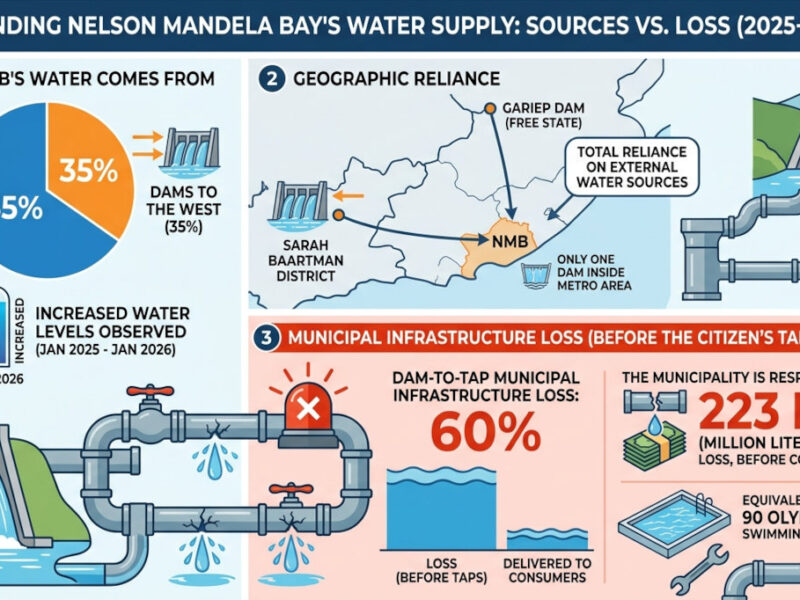
South Africans and thirsty Nelson Mandela Bay residents, the numbers are in, and they paint a critical picture of Nelson Mandela Bay's water supply. Whilst one significant dam level has increased, the biggest leak isn’t in the Western Region; it's in our municipal infrastructure. Here are the facts: 65% of Nelson Mandela Bay's water comes from the Gariep Dam, which saw rising levels throughout 2025. Nelson Mandela Bay has a TOTAL reliance on external water sources (Free State and Sarah Baartman Districts). 35% of the municipalities water comes from dams to the west, four of which fall within the Sarah Baartman District. BUT... 60% of that water is lost BEFORE it reaches consumers taps due to municipal infrastructure failure. What does that mean? The municipality is responsible for wasting 223 Million Liters per day (MLD). That is equivalent to losing 90 OLYMPIC-SIZED SWIMMING POOLS DAILY. We are importing water from across the country, only for more than half of it to disappear through broken pipes. We cannot afford this waste. How We Fight Back: We must turn this data into collective action. We can't wait for the municipality to fix it; we have to develop our own pressure map. Join the Discussion: What is the water pressure like in your street? Have you reported a leak with zero feedback? Report the Leaks: Share your municipal reference number on the forum. We use this data to escalate entire neighborhoods, bypassing the call center queue. Don't just watch the 90 Olympic size pools drain daily. Take control. Join the MyNMB Forum to express your feelings, share solutions and vent! #NelsonMandelaBay #Gqeberha #NMBWaterCrisis #ServiceDelivery #CommunityAction #TheMyNMBWay Infographic: Links: MyNMB Forum NMB Drought Status: The Big Con …
Track Your Press Release HERE:

Beat The Electricity Price Hike With a Shelly Pro 1PM: The Professional Single Phase Energy Monitor
With households scrambling to save money on electricity costs ahead of Eskom's looming price hike many are turning to Solar Systems as a solution. The concerns with Solar are mainly around cost to install and speed of installation. The principle around saving electricity is a simple one; "If you can measure it, you can manage and control it!" Shelly Devices: Shelly Devices offer you a very cost effective way to constantly measure your consumption and control it - on an entire premises OR single device basis - via your smartphone and WITHOUT ongoing monthly connection costs. Your device, your data, your privacy - sorted. Take absolute control of your electricity bill with the Shelly Pro 1PM. Designed for the professional environment and high-demand South African households, this DIN-rail mountable 1-phase energy meter provides 1% billing accuracy. In the Nelson Mandela Bay area, crossing into the "Block 3" tariff will spike your costs to R4.57 per unit (ecl. VAT). The Shelly Pro 1PM allows you to track consumption in real-time, identifying exactly which phase or appliance is pushing you toward that expensive 500kWh threshold. The Shelly Pro 1PM is the gold standard for automating the single biggest energy consumer in your home: the geyser. Capable of switching up to 16A (3.5kW), this compact relay fits directly into your existing isolator box or DB board. Unlike traditional mechanical timers, the Plus 1PM provides precise power measurement, allowing you to see exactly how much each shower or bath is costing you. By automating your geyser to heat during off-peak hours and utilizing "thermal mass" strategies, you can significantly reduce your monthly consumption and avoid high-tier municipal penalties. Why Shelly Pro1 PM: Overpower Protection: Integrated temperature and power sensors for peace of mind. Advanced Scheduling: Create complex 7-day schedules or use "Sunrise/Sunset" logic. Connectivity: Works via Wi-Fi and Bluetooth—no …
Track Your Press Release HERE:
Straton Electrical Weighs In on SONA 2026: A Vision for Infrastructure, but Execution Concerns Remain
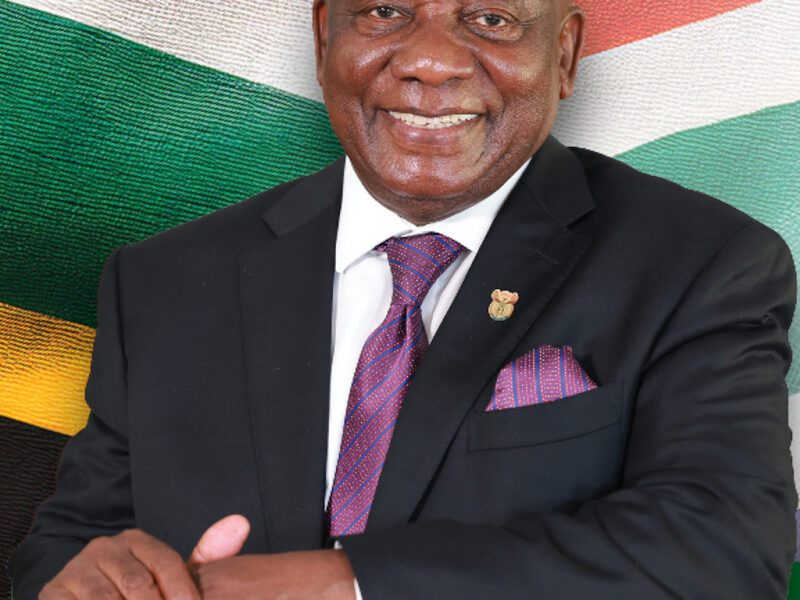
GQEBERHA – Following President Cyril Ramaphosa’s State of the Nation Address (SONA) delivered on 12 February 2026 in Cape Town, Straton Electrical - a leading electrical contracting firm in the Eastern Cape - has critically examined the President's roadmap for the energy sector. While the speech signaled a historic pivot toward a competitive electricity market, the local contracting industry remains cautious about the transition from high-level policy to "boots on the ground" implementation. The "Good News": Opportunities for Growth Straton Electrical welcomes several key announcements that provide a clear runway for the electrical contracting and renewable energy sectors: End of the Eskom Monopoly: The President’s confirmation of a fully independent state-owned transmission entity (separate from Eskom Holdings) is a watershed moment. This leveling of the playing field is expected to accelerate Independent Power Producer (IPP) projects, creating a massive demand for private electrical grid-tie and substation infrastructure. The 40% Renewable Target: The bold commitment to have 40% of South Africa’s energy supply come from renewable sources by 2030 ensures long-term work for solar and wind contractors. The introduction of a 150% tax deduction for New Energy Vehicles (NEVs) and battery manufacturing further incentivizes industrial electrical upgrades. Infrastructure Spend: The allocation of R940 billion for infrastructure over the next three years—including R375 billion by state-owned companies—promises significant sub-contracting opportunities in the revitalisation of national power systems. Eradication of "Load Reduction": The focus on provinces to address transformer overloading and illegal connections is a direct call to action for local contractors. Modernizing the distribution network is essential for the safety and stability of our communities. Areas of Concern: The Challenges Ahead Despite the optimism, Straton Electrical identifies …
Track Your Press Release HERE:

Turn Your Website Into a Submission Engine With Gravity Forms
If you have ever visited Gqeberha based MyPR.co.za, you’ve seen one of the most efficient uses of WordPress automation in South Africa. MyPR handles thousands of press releases annually, but they don't have a team manually re-typing every submission. Instead, they use Gravity Forms to do the heavy lifting. The MyPR Workflow: From Form to Draft in Seconds Most people think a form is just for "Contact Us" pages. MyPR uses Gravity Forms for Front-End Content Submission. When a PR professional submits a release on MyPR, the form is mapped directly to WordPress Post fields. The Title becomes the Post Headline. The Body becomes the Post Content. The Featured Image/s is/are automatically uploaded to the Media Library. The Result? The release appears instantly as a "Pending Draft" in the WordPress backend AND and displayed on the 'Coming Soon' page, ready for an editor to review and publish with a single click. Why Gravity Forms is the Industry Standard Whether you are building a news portal like MyPR, a job board, or a complex registration system, Gravity Forms offers the reliability that free plugins simply cannot match. Post Creation Add-On: This is the "secret sauce." It allows you to turn any form submission into a WordPress post or custom post type automatically. Advanced Conditional Logic: Show or hide fields based on user input, ensuring your users only see what they need to see. Secure File Uploads: Handle high-resolution images and PDFs with built-in security protocols. Bulletproof Integration: Connect your data to Mailchimp, HubSpot, or Zapier seamlessly. Build Your Own Professional Workflow Don't let manual data entry slow your business down. If you want to scale your site's functionality - whether for press releases, guest blogging, or user-generated content - you need a tool that handles the complexity for you. Experience the power of the most advanced form builder on the market. Get started with Gravity Forms today …
Track Your Press Release HERE:
Question: Shouldn’t We ONLY Invest in JSE Listed Businesses Paying Large Tax Bills?
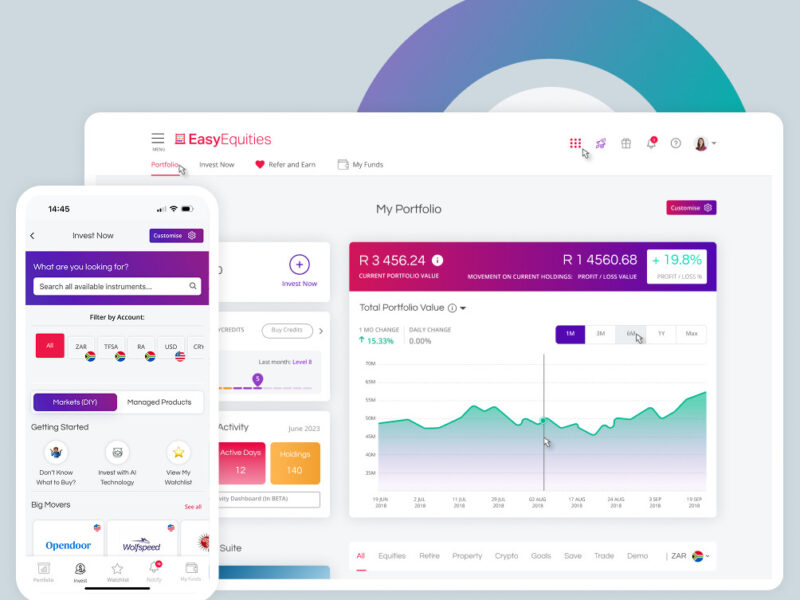
Receive a sign up bonus from EasyEquities with our compliments. Then you should consider adding the stocks below to your EasyEquities portfolio... In South Africa, corporate income tax (CIT) is heavily concentrated. According to recent SARS data, a tiny fraction of companies—roughly 0.2% of all assessed businesses—contribute nearly 60% of the country's total corporate tax revenue. The primary contributors are dominated by the "Big Four" banks and major telecommunications firms. Based on the 2024/2025 fiscal reports and PwC’s Major Banks Analysis, here are the JSE-listed companies that pay the largest amounts of direct tax to SARS: 1. The Financial Sector (The Heavyweights) The banking sector is consistently the largest contributor to CIT. In 2023/2024, the major banks paid a combined total of over R37 billion in direct taxes. Company Name - Estimated Annual Direct Tax (SA) Standard Bank Group - ~R12.72 billion FirstRand Limited (FNB/RMB) - ~R12.59 billion Absa Group - ~R8 billion+ Nedbank Group - ~R4.43 billion Capitec Bank - ~R2.88 billion 2. Telecommunications Telecom giants are critical contributors due to their massive domestic consumer bases and consistent profitability. MTN Group: Reported approximately R7.5 billion in total income tax for the 2023/2024 fiscal year. Vodacom: Contributed roughly R4.4 billion in direct taxes (with a total public finance contribution, including indirect taxes, of over R13 billion). 3. Retail and Consumer Goods Shoprite Holdings: As Africa's largest retailer, they paid roughly R2.46 billion in South African income tax alone. Naspers/Prosus: While much of their revenue is international, their South African operations contributed roughly R2.14 billion in the most recent fiscal period. Sector Performance Trends (2025/2026) The "Top Taxpayer" landscape has shifted slightly recently due to economic conditions: Mining Sector Decline: Historically, miners like Anglo …
Track Your Press Release HERE:

Are You Throwing Money Away?
Two recent incidents have prompted Straton Prepaid to expand on this subject. The first one was a personal wake-up call: I recently renovated my flatlet and installed a new Sub DB with new wiring. Unfortunately, the existing prepaid meter was 'tossed' out in the rubble. It took me a few months to upgrade my main distribution board and re-connect my manual meter reading the flatlet consumption. Yes, the one is a fail safe for the other! When I finally got around to reading my manual meter I received a bit of a shock! My tenant has been consuming just over R2000 in electricity per month, for which I have been paying. A new prepaid electricity meter has been installed and recoveries have begun again. Now - the price to the consumer for supply and installation to a flatlet with a sub distribution board that complies is under R2000.00 So - for less than one month's worth of electricity I will now recover my tenant's usage for years to come (or, until the next renovation). The second was from a recent quotation: The client owns a building in an industrial area in Gqeberha. At present the tenant pays R12000 per month in rental. The rental includes electricity and water. The municipal electricity bill to the owner is just over R13000 per month. Factor in water consumption, rates, maintenance, estate agent commission etc and the owner is on a slippery path to nowhere. Three phase Prepaid Electricity Meter: Sure, the electricity supply is three phase to the building and installation will cost a tad more but certainly NOT R13000. So, the client could save R13000 per month for years just by spending half of that amount on the supply and installation of a 3 Phase Prepaid Electricity Meter. A MAGNIFICENT ROI for any landlord. Presently we install the Hexing HXE310-P (PLC) - a three-phase, 100A, split-type prepayment meter commonly used for smart electricity metering. It operates with a Customer Interface Unit (CIU) that communicates …