

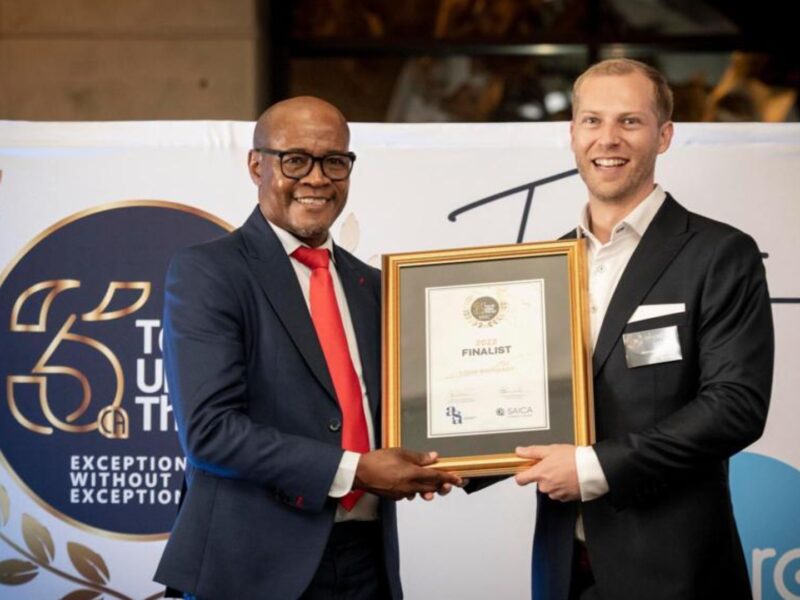
Cape Town - Outsourced CFO (OCFO) has been named Zoho Emerging Partner at the recent Zoho Partner Inspire event held in November at the Vineyard Office Estate in Cape town. At the same event OCFO received its certification authorising it to be an official Zoho partner. Zoho is a comprehensive software suite of business applications that helps business owners run their entire business from one place by automating various functions. It offers businesses a vast range of tools to handle every function, from customer service, social media, intra-company communications, and performing Human Resource functions. Zoho offers a plethora of add-ons and customisations which allows every customer to tailor a system that works uniquely for their business. Outsourced CFO, co-founded by local businessmen Louw Barnardt and Dana Pretorius, has rapidly expanded in less than a decade to be a dominant player in the realm of outsourced CFO services, helping clients automate their business and improve efficiencies within the business to create an environment for scalable growth while maximising profitability. OCFO currently services over 700 clients in 18 countries, and has recently opened a subsidiary office in New York. The South African Institute of Chartered Accountants announced Barnardt as the winner in the Lead Category for the South African Institute of Chartered Accountants’ Top 35 under 35 competition of 2022, at its annual gala event in November. “At OCFO we trust Zoho as the enterprise-wide CRM system of choice, and use it as part of our automation toolkit for all our clients. Zoho CRM acts as a single repository to bring sales, marketing, and customer support activities together, and streamlines the customer retention process,” says Barnardt. “We are honoured to be recognised as an up and coming Zoho partner, and look forward to a productive working relationship between ourselves and Zoho, while sharing the benefits of Zoho software implementation with …

What are Dividends and How Do They Work?
What precisely is a dividend? We frequently hear about dividends, shares and yields when speaking about evaluating corporations. One of many massive misunderstandings is what dividends are, how they work and the way they will profit you as investor or shareholder. Briefly, a dividend is a reward paid to the shareholders of an organisation for his or her funding in an organisation’s fairness, and it normally originates from the corporate’s web earnings. We predict we all know what a dividend is, however as a businessperson it pays to know precisely how and when corporations pay dividends, in addition to the several types of dividends on the market. Because the proprietor and director, you also needs to be desirous about receiving dividends out of your firm. Which is best – dividends or a director’s wage? Each have completely different tax implications. Let’s dive in. Dividends are common profit-sharing funds made between an organisation and its traders, and the value is decided by the board of administrators. Dividends are paid in keeping with how a lot inventory an investor or shareholder owns, normally as a proportion to the proportion of fairness owned, and could be paid month-to-month, quarterly, semi-annually or yearly. Firms pay dividends for a lot of completely different causes, together with to draw and retain traders. Dividends are enticing incentives for shareholders, in order that they know that the corporate they’re investing in is worthwhile and that there’s a good risk of future earnings. Not all corporations, nonetheless, pay dividends, some select to reinvest earnings again into the enterprise. For an organization to share earnings with traders, it should even have earnings to share. Consequently, dividends are commonest from well-established corporations that generate constant income, versus startups. Shares of such corporations are normally often called earnings shares and pay common dividends. Completely different Kinds of …
Track Your Press Release HERE:
SAICA Lead Winner for Top 35 Under 35 Announced.
Johannesburg - The winner for 2022 of the Top 35 under 35 competition was announced at a prestigious gala dinner hosted by the South African Institute of Chartered Accountants (SAICA) on Friday 25 November 2022 in Johannesburg. This initiative was started by SAICA in 2014. The Top-35-Under-35 competition recognises young CAs(SA) achievers who are not only excelling in their professional capacity, but who are also making a meaningful contribution to society. Louw Barnardt (age 34), CEO and co-founder of Outsourced CFO was announced as the winner in the Lead Category for the South African Institute of Chartered Accountants’ Top 35 under 35 competition of 2022. Barnardt started the award-winning finance firm Outsourced CFO with fellow Top 35 chartered accountant Dana Pretorius at the end of 2013. Under his leadership as managing director, the company has grown from two desk spaces to seventy people in just under nine years, posting more than an average of 50% growth per year. Outsourced CFO now serves clients from over 25 different countries around the world, and their staff operate from six provinces in South Africa and three continents around the world. No stranger to winning awards, Barnardt has been recognised as a Top 35 chartered accountant (2015/16), a Top 3 finalist for Young Professional of the Year (SAPSA Awards 2016), and the Sanlam/Business Partners Emerging Entrepreneur of the Year winner (EOY Awards 2018). He has been included among the Fast Company Top 20 under 30 (2016), the Fast Company Most Productive People in Business (2018) and Insights Success magazine’s Top 40 under 40 (2021). Barnardt is passionate about making a difference in the entrepreneurship and business community, especially when it comes to transfer of hard- and soft-skills of entrepreneurs from previously disadvantaged backgrounds. Not satisfied only with his professional career, Barnardt also spearheaded the formation of Founders Foundation NPC, a non-profit vehicle …
Track Your Press Release HERE:

Leverage outsourcing in stages of high growth and access the skills to overcome any challenge
A founder’s journey is a rollercoaster. Some of the highest highs and lowest lows a human can experience are tied to the quest for business success. One of the most exciting times in an entrepreneur’s life is when a business starts to gain real momentum. Leading a business is no easy task – especially in a high-growth environment. Things move fast. Faster than usual and pressure continues to build with the endless tasks and situations to consider. How strong is our product/market fit? What is our customer retention like? Why is our CAC increasing? What talent do we need and where are we going to find it?? Sales, operations, tech, marketing … people. The tasks are endless, time is finite and your skill set – although great – is limited. Ever feel overstretched? Finance is complex and the finance function is often one of the last frontiers to get fortified by the leadership team. It is also one that becomes increasingly more important as you head towards further expansion, possible fundraises and potential acquisitions. Getting the numbers right is critical. So is developing the right strategy based on analysis, forecasts and smart financial management. High-growth environments, although great, can start to have adverse effects on a founding team. As growth increases, so does the workload, variability of tasks, and complexity of challenges. What does not increase is time, and working longer, more difficult hours – without the right support – will lead to mistakes and burnout. But does outsourcing make sense for my company? If some of the below situations seem all too familiar, you are most likely experiencing the symptoms of continued high growth over an extended period. It may be time to consider accessing expert help: Inability to hire quickly enough Difficulty in finding the right talent, with the right skill set Employee churn as a result of burnout Industry-specific challenges requiring specialised knowledge Dated or lack of the …
Track Your Press Release HERE:

6 Ways to Reduce Overhead Costs
We’ve said it before, and we’ll say it again - cash is the lifeblood of every business. Without money flowing in, you are dead in the water. But how do we ensure that there is enough cash circulating? Cut costs and overheads and increase sales in order to maximise profit. What is profit and how do you calculate it? In short, profit is revenue minus expenses. Profit is the amount of money you have left once your total costs and expenses have been deducted from your income. Obviously, the higher the number the better, and you should always aim to maximise profit. If your costs are higher than your income, however, then you are running at a loss and the end is in sight for your business venture. Why profit is important for your cash flow Cash flow represents the cash coming in and flowing out of your business. When cash going out is subtracted from cash going in, you are left with net cash flow. Profitability represents the income minus the expenses, fixed and otherwise, of your business. When expenses are subtracted from income the resulting number shows your profit. Cash inflows and outflows show liquidity while income and expenses show profitability. Liquidity is a short-term phenomenon: Can I pay my bills? Profitability is a medium-term phenomenon: Am I making money? Needless to say, profitability in the long term is where it’s at. How to Cut costs and improve profit It sounds simple, right? Cut costs and have more money in the bank. However, the reality can be more complex, as you do need to spend some money running your business, and some input costs are unavoidable. It's all about money in AND out and finding the ideal balance that allows growth. Reducing costs doesn’t simply mean cutting spending to the bone and leaving it at that. You need to understand the nature of each cost and its relationship to your company’s sales and profits, and learn to spend - or save - wisely. Here are 6 sensible ways to cut down on expenses and ultimately …
Track Your Press Release HERE:

The Benefits of Outsourcing your Accounting and Audit Needs
Accounting might be the process of recording business transactions after they happen, but that doesn’t mean entrepreneurs can treat it as an afterthought. Accounting services should be about more than just bookkeeping and financial admin. Instead, good accounting services can help you to analyse transactions that happened in the past to gain valuable insights to plan for the future. It can offer the financial guidance your business needs to ensure its growth and financial success. But whether you are a small business (with an even smaller team) or a more established company that is scaling up, you may not always be able to rely solely on the accounting expertise on your own payroll. Outsourced accounting services can give your business access to expert accounting and tax advice exactly when you need it. What does your accountant do? Accountants produce the vital documents you need to run your business. They audit your books, prepare reports for tax purposes, and generally oversee the everyday financial functioning of your business. Your accountant helps you to keep track of the money going in and out of your business on a daily, weekly, and monthly basis. Yet, they also play a valuable part in determining its long-term financial health. An accountant’s duties might include: Handling all payroll administration and entries Working with your auditors to prepare the necessary reports Preparing and reviewing budgets, revenue, expenses, invoices, and other accounting documents Preparing profit and loss statements and monthly closing and accounting reports Analyzing cash-flow and making necessary recommendations Compiling and analyzing general ledger accounts, and documenting business transactions Resolving accounting discrepancies Implementing of accounting and accounting control procedures as well as systems automation Developing, and maintaining financial databases and computer software systems What are the benefits of …
Track Your Press Release HERE:

5 Tips for Hiring an Outsourced CFO
As an entrepreneur, you probably feel like you have to be the chief cook and bottle washer in your growing business. But can you also be the chief financial officer (CFO)? It may be possible to do it all yourself when you are just starting out. But as your business expands you will soon need someone that can do more than just “take care of the books”. What does a CFO do? The chief financial officer or CFO of a business is responsible for managing and overseeing the long-term financial health of the company. This role includes tasks such as tracking your cash flow, analysing your company’s financial strengths and weaknesses, and suggesting steps to remedy any problems. A qualified and experienced CFO can play a pivotal role in helping you to make the right strategic and financial decisions. A good CFO is not only responsible for your company's current finances but can also help you to predict and drive its future growth. Why hire an outsourced CFO? A qualified CFO can provide valuable insights to help entrepreneurs when making the many critical decisions needed to scale a business. However, even if they could afford one, very few small and medium-sized businesses (SMEs) can really need the amount of advice and oversight that a full-time CFO provides. SMEs don’t need 2,000 hours of a CFO’s time – they just need the right advice at the right times during the year. Outsourced CFO solutions solve this problem by giving smaller businesses access to the same high-calibre professional CFOs that big businesses rely on. A virtual CFO or outsourced CFO fulfils all the tasks a regular CFO does, but without being permanently employed in-house at your company. While most highly experienced CFOs would not be willing to take up a permanent position at an SME, they may be able to devote 25 hours a month to high-level oversight and assistance when you need it most. A part-time CFO can help you free up your time as a business owner to focus on what you do best. …
Track Your Press Release HERE:

How CFOs leverage outsourcing in periods of high growth
"Do what you do best and outsource the rest!" - Legendary business consultant Peter Drucker The growth and expansion phase is an exciting time for any company. However, business leaders often underestimate the intense pressure that goes hand in hand with rapid business growth. As CFO at the head of finance, you are responsible for the delivery of the financial function priorities of the company. Your tasks are the most complex, and your demand the highest. It’s also likely that key operations matters often require your input, making your time a highly scarce resource. Ever felt overstretched Having to oversee everyday administrative work draws your attention away from vital higher-order financial functions such as the direction of the company’s financial strategy and forecasting and projections – the cornerstone for sustainable growth. High-growth environments, although great, can start to have adverse effects on a finance team. As growth increases, so does the workload, variability of tasks, and complexity of challenges. What does not increase is time, and working longer, more difficult hours – without the right support – will lead to mistakes and burnout. Does outsourcing make sense for my company? If some of the below situations seem all too familiar, you are most likely experiencing the symptoms of continued high growth over an extended period. It may be time to consider accessing expert help: Inability to hire quickly enough Difficulty in finding the right talent, with the right skill set Employee churn as a result of burnout Industry-specific challenges requiring specialized knowledge Dated or lack of the correct system and integration Poor information flow through the organization How can outsourcing work for me? You may be thinking “is this really an option?” We’ve integrated with companies from over 25 countries, leaning on the cross-pollination of data and our shared knowledge base to support CFOs and finance teams …
Track Your Press Release HERE:

Outsourced CFO to host fifth Founders Conference in Cape Town
Cape Town - Outsourced CFO is excited to host its fifth Founders Conference - a leading SME event created to connect, inspire and motivate South African entrepreneurs from all industries. As Outsourced CFO’s flagship event, Founders Conference brings together successful business leaders and fellow entrepreneurs to network and share their experiences and insights. The high-energy conference features several short, jam-packed keynotes and panel discussions by top founders and dynamic speakers. Outsourced CFO is passionate about helping founders to scale and grow their businesses using expert CFO services, Cloud Accounting, and Automation software. Louw Barnardt, Co-founder and Managing Director of Outsourced CFO, says successful entrepreneurs also recognise the importance of learning and exchanging ideas.“Entrepreneurship can be a lonely road. Outsourced CFO wants to bring together founders to support each other, learn from each other, and be energised by each other. The energy in the room at Founders Conference is always infectious.” Barnardt says Founders Conference is not just a meaningful networking opportunity but will also leave attendees with actionable insights to apply in their businesses. “This event has become a pillar in the entrepreneurial ecosystem and is not to be missed by any serious founder.” Founders Conference takes place on 22 November in Cape Town from 17:00 to 20:00 and is sponsored by Xero and Zoho. Visit https://www.foundersevents.co.za/ to secure your spot. About Outsourced CFO: Founded in 2013, Outsourced CFO is an award-winning CFO Services, Cloud Accounting and Automation company. We serve rapidly growing organisations, helping them to realise the impact of their vision. Our team consists of sixty innovative finance professionals, and has served over 700 companies in 18 countries around the world. Drawing from deep technical and professional wells of expertise, we help founder and management teams build world-class …
Track Your Press Release HERE:

A Bleak Christmas Ahead for South Africans
Johannesburg - South African consumers face more tough days ahead with inflationary pressures forcing the Reserve Bank into corners and the Treasury left with little options beyond 2023. Inflation continues to be on the lips of the average consumer as food and transport prices dig deep into pockets of already over-extended consumers. The Reserve Bank’s Monetary Policy Committee meets again on 24 November 2022, with economists predicting a further increase of 50 basis points on the REPO rate, which is the official rate at which banks borrow money. This in turn will lead to banks increasing the Prime lending rate, taking more money out of consumer pockets. But the Reserve Bank has very little options. It needs to push inflation back into its 3% to 6% range or else face a pricing spiral, led mainly by companies agreeing to above-inflation wage demands. Pricing spirals occur when inflation increases because companies give larger salaries, adding liquidity into the market. The greater the liquidity, the greater the inflation, pushing prices further up, which then pushes up wage demands, causing the pricing spiral. While oil prices are looking bearish, the energy crisis in Europe is weighing down on the South African economy. This is because South Africa imports its petrol and diesel. Diesel prices are at record highs as European demand is pushing up prices. South Africa’s exchange rate to the dollar and Eskom burning diesel to keep the lights on has added further local pressure, with a massive under-recovery for October. This will undoubtedly lead to another big jump in diesel prices in the first week of November. Strikes at Transnet over the last two weeks have caused havoc at South African ports, leading to millions of rands in losses across multiple industries. A higher repo rate is in fact likely to do very little to ease inflationary price pressure because inflation is currently not driven by higher demand but by international pressure on …