
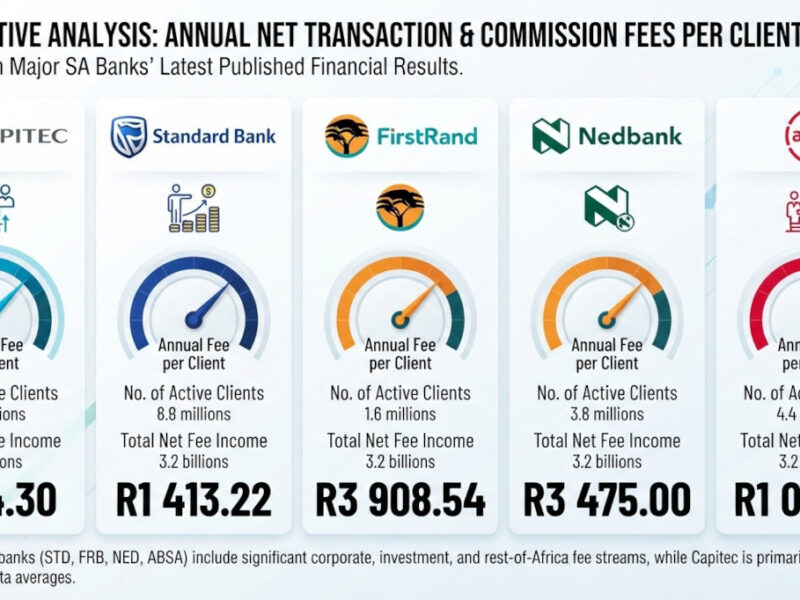
A comparison of the average annual fees collected per client, per bank. Want to know which bank collects the highest fees and commissions per client, per annum? Which Social Media Site Collects the highest ARPU per annum? The one thing that irks me no end about the banking industry is the amount of money we pay to banks to process and handle our money. Agreed - people who owe money on loans etc. need to be charged an interest rate, but, to watch your account balance assaulted by bank charges when you have a positive balance AND that money is being used to support the banks main product of lending money is just irksome. Wandering through Standard Bank this morning I was impressed at the building and décor - lots of bulletproof glass, CCTV, leather chairs and a decidedly upmarket look. In comparison to Capitec which is very minimalistic and not over the top - it just works for me and my tradesman's brain. At this stage I need to tell you about a lesson that my late Father learned in his choice of personal vehicle as an electrical contractor. He always wanted a Mercedes 450 sports car and, when he finally snagged one it was his pride and joy. He part traded in on his Mercedes 280S and we had great fun driving topless. BUT Clients looked at this tradesman in his fancy car, thought (and told him to his face) that he must be ripping them off in order to afford this beauty of a car. So, business actually went down forcing him to sell the 450 at a loss and buy back his Mercedes 280S. So what is it about professions when we look at their buildings, vehicles and décor and shy away from those visibly living frugally UNLESS it is a tradesman getting their hands dirty doing jobs the average man would never tackle? Back to Standard Bank - my first thought is always; "Clients pay for all this, I wonder what would happen if the bank scaled down?" Basically every bank has as it's main source of income directly from it's clients in Fees and …

Making Money but Still Wondering Where It All Went?
Chartered accountant and entrepreneur Nokuhle Kumalo-Chamoto tackles the money lessons business owners often learn the hard way at Workshop17 West Street this September You have landed the client, sent the invoice and watched the money come in, but once payday arrives, tax is due, suppliers need settling and someone pays late, that healthy-looking bank balance can start to feel a lot less healthy. Cash flow has a habit of becoming interesting at precisely the moment it becomes uncomfortable. On Wednesday, 30 September, chartered accountant, entrepreneur and financial educator Nokuhle Kumalo-Chamoto will tackle the subject at Workshop17 West Street in Sandton during the next instalment of Workshop Wednesday. Titled “Outsmart Your Cash Flow”, the session will unpack the money lessons business owners often end up learning through experience, sometimes expensively, and show how a better understanding of the numbers can lead to smarter business decisions. Kumalo-Chamoto, CA(SA), is the founder of Lomaku, an author, speaker and personal finance creator known for making financial concepts easier to understand and apply. Her Workshop Wednesday conversation will bring that same practical approach to entrepreneurship, with a focus on cash flow, commercial trust and building a business that can hold its own when conditions get tougher. Revenue is only part of the picture A busy month can feel like a good month. New work comes in, invoices go out and turnover looks encouraging. But turnover cannot pay the bills if the cash is not there when it is needed. Late-paying customers, tax commitments, rising costs and blurred lines between personal and business spending can put pressure on a company long before the owner realises there is a problem. “Cash flow can sound technical, but the questions behind it are incredibly practical,” says Penelope Meniere, National Marketing Manager at Workshop17. “Can I afford to hire? Can I take on a bigger contract? How …
Track Your Press Release HERE:

New SAFPI Data: 56% of Debt-Review Applicants Now Commit More Than Half Their Income to Debt
JOHANNESBURG, SOUTH AFRICA — More than half of South Africans applying for debt review are already committing more than half of their net monthly income to debt repayments, according to the latest reading of the South African Financial Pressure Index (SAFPI), published by Debt Solutions 4U. The August 2026 SAFPI reading puts the median debt-to-income ratio among debt-review applicants at 58.4%, based on 1,174 applications in the rolling June-to-August dataset. A total of 56.0% of applicants were already committing more than half of their income to debt repayments before accounting for everyday essentials such as food, transport and housing. The latest dataset also shows the concentration of unsecured debt in personal loans. Personal loans accounted for 65.4% of the R79.02 million in unsecured balances recorded across 5,842 accounts in the June-to-August period. The figures come from anonymised debt-review application data collected by Debt Solutions 4U, combined with account-level credit bureau information. The organisation stresses that SAFPI measures the depth of financial pressure among people already seeking debt assistance, rather than attempting to estimate the level of debt pressure across the entire South African population. "One of the most important things about this data is understanding what it does and does not tell us," says Rowan Breeds, NCR-registered debt counsellor (NCRDC2423). "These are people who have already reached the point of seeking help. The 58.4% figure therefore tells us how severe the pressure is within that group, rather than suggesting that the typical South African household is spending 58.4% of its income on debt." The latest SAFPI dataset also highlights a significant information gap among people seeking assistance. Of 786 applicants asked about their debt-review status before an NCR register check, 51.3% said they were unsure whether they were already under debt review. Where applicants' answers could be compared …
Track Your Press Release HERE:

Schneider Electric Concludes Innovation Summit Middle East & Africa, Highlights Energy Intelligence as the Next Phase of the Energy Transition
AI, electrification and industrial expansion reshape energy demand across the Middle East and Africa, Schneider Electric today concluded Innovation Summit Middle East & Africa by positioning energy intelligence as the next phase of the energy transition - where infrastructure becomes more connected, resilient and software-defined. Held at ADNEC in Abu Dhabi, the two-day summit convened over 2,500 attendees, including government leaders, industry analysts, customers, partners, students, and media, under the theme ‘Advancing Energy Tech to Power Intelligence and Resilience.’ Industry leaders explored how electrification, AI-ready data centers, cybersecurity, and digital innovation are reshaping energy systems. Day one featured keynotes from H. E. Abdullah bin Touq Al Marri, UAE Cabinet Member and Minister of Economy and Tourism, and Schneider Electric CEO Olivier Blum, in the presence of H.E. Marie Audouard, Ambassador Extraordinary and Plenipotentiary of the French Republic to the UAE. The summit also featured the launch of the Innovation Hub, the Data Cube, and Olivier Blum’s address on “The Era of Intelligence.” “We’re entering an Era of Intelligence in which AI is becoming embedded in the physical economy. AI may be digital, but it runs on electricity and depends on the physical systems beneath it,” said Olivier Blum, CEO of Schneider Electric. “As an Energy Technology Partner, we help customers connect energy and operations through data, software, AI and automation, turning intelligence into action to improve performance, resilience and competitiveness. The scale of this shift is clear in the Middle East and Africa, where governments and businesses are investing in energy and digital infrastructure to support industrial transformation and long-term growth.” The summit also featured the release of the company’s 2026 Industrial AI in CPG Study for the UAE, which found that 59% of UAE manufacturers expect transformational AI adoption by 2030, …
Track Your Press Release HERE:

Pay@ Sets Out Small Business Payment Options for Spring
For South African businesses, September rarely stands still. The bills that go out this month are the ones that will decide how trading holds up through the closing quarter, and the gap between raising an invoice and watching the funds arrive is exactly where smaller companies bleed momentum. Pay@, the Stellenbosch based payment solutions provider that has handled bill payments since 2007, is treating the turn of the season as a moment to lay out the collection channels it opens up to organisations of any scale, running from a single API integration designed for high volume billers all the way to a self-service portal pitched directly at the SME market. At its core, the business works as a bill payment aggregator. Instead of leaving a company to strike its own deals with every retailer, bank, mobile network and digital wallet, Pay@ holds those relationships for the biller and surfaces them through a single connection. The company's own website puts that reach at more than 40 separate payment networks across its retail and digital partners, alongside more than 500 billers whose accounts customers can clear using a unique Pay@ reference number. Two routes into the same payment network The offering is framed as two separate ways in, and which one fits usually hinges on whether a company is already running a billing system of its own. The enterprise path is the Integrated Solution. It connects to an existing invoicing or account management platform and passes the entire transactional flow across to Pay@, covering bill presentment, real time bill validation, payment confirmation and daily reporting. Bills can go out in a broad set of formats, including printed invoices, PDF documents, SMS, QR codes, payment links, in-app screens, web based pages, eCommerce checkouts and USSD. Two integration methods are on offer: the Online API, which pushes real time validation and payment notifications to an endpoint the business supplies, or a file based method in which …
Track Your Press Release HERE:

RM Capital: What Makes a Purchase Order Fundable
Ask RM Capital to settle a supplier against a confirmed order and it will run the transaction through a defined set of practical checks. The niche funder, based at Melrose Arch in Illovo, Johannesburg, has now spelled out what those checks are. With September opening the run in to the last quarter of 2026, South African suppliers face a stretch in which orders have to be fulfilled ahead of the December shutdown, and for many the bottleneck is not a shortage of buyers. What holds them back is the cash needed to buy the stock in advance. RM Capital funds businesses in a wide spread of industries across South Africa and presents itself as a handy alternative to the mainstream banks for firms that cannot line up bank finance quickly yet already have the groundwork for long term success. What the facility actually covers RM Capital describes Purchase Order Funding, a facility it also calls tender order funding, as a way for a business to pay its suppliers for goods it plans to resell or distribute to a customer who has issued a written purchase order. That distinction is important. This is not a general working capital loan that arrives in a bank account for the business to spend as it pleases. The money is tied to one transaction, one order and one customer, and it goes to the supplier so the goods can be made, released or shipped. Because of that structure, the facility can serve businesses a conventional lender would struggle to assess. A young firm with a slim balance sheet and no property to offer as security may nonetheless be holding a signed order from a large corporate buyer or a government department. It is the order itself that is being financed as a commercial event, and much of the weight rests on the standing of whoever placed it. The five steps the company works through On its website RM Capital breaks the process into five stages. First the business hands over the purchase order along with its supplier documentation. Next it supplies its own …
Track Your Press Release HERE:
Stanchion Payments Continues Its Growth Trajectory With New African-Focused Appointment
Johannesburg, South Africa - Stanchion Payments has announced the appointment of Carlin Wicomb as Regional Managing Director: Africa. Carlin brings over 15 years of experience in payments and fintech throughout Africa and emerging markets, combining deep technical expertise with a strong track record in commercial leadership. Given the company’s ambitious expansion plans, Carlin’s experience in building and scaling operations in Sub-Saharan Africa will play a key role in growing the Stanchion Payments brand. In his new role, Carlin will drive the development of the region with a particular focus on accelerating adoption of Payment Fabric™ among issuing and acquiring banks. Drawing on his experience helping financial institutions modernise without replacing existing infrastructure, he will work closely with banks and partners to deploy Payment Fabric™'s overlay capabilities. This includes tokenisation and digital wallet enablement to card security and PIN management, on top of the systems they already run, while continuing to build Stanchion Payments' presence in high-growth African markets. Alongside the focus on Payment Fabric™, Carlin will also lead efforts to grow Stanchion Payments' ACI Postilion business across the region, both supporting existing Postilion customers and actively pursuing new ones. With Stanchion's proven Postilion skills and managed services capabilities, he is well-positioned to offer financial institutions the expertise and continuity they need to run and evolve their Postilion environments with confidence. “Carlin's appointment strengthens our leadership in one of our most important regions. His experience building and scaling payments businesses, combined with his technical strength in issuing, acquiring and switching, is exactly what our customers and partners across the continent need. We're delighted to have him on board,” said Steve Kirrage, Chief Executive Officer, Stanchion Payments. Kirrage says Carlin is a great …
Track Your Press Release HERE:
Turning Compliance Into a Business Enabler: How VOCA Has Been Reshaping the FICA Landscape for the Past Two Years
Cape Town, South Africa – Compliance has traditionally been associated with paperwork, manual checks and the challenge of proving that the right processes were followed. But as regulatory scrutiny increases and accountable institutions face greater expectations around customer due diligence, the industry has been moving towards a more practical question: how can compliance become easier to manage, evidence and maintain? As VOCA, SW360’s Verification, Onboarding and Compliance Application, marks two years in the market, its significance lies less in the milestone itself and more in what it represents: a shift towards making FICA compliance part of everyday business rather than an administrative exercise that happens around it. “Compliance should not be something businesses have to reconstruct when an audit or regulatory review happens. The evidence should already exist as part of the process,” says Sameer Kumandan, Managing Director at SW360. “VOCA has helped move that thinking forward by making compliance more practical, traceable and easier to demonstrate.” A key part of this shift is the electronic audit trail. By automatically recording verification and compliance activity, businesses have a clear record of the checks performed and the decisions made. This creates an evidentiary trail that can be particularly valuable during FIC audits, while reducing reliance on disparate documents, emails and manually maintained records. The result is a move away from compliance as a collection of individual checks towards a more connected process. Verification reports, risk ratings and supporting information can be accessed through a centralised digital process, while KYC and KYB checks, CIPC checks, ID verification, PEP (politically exposed persons) and sanctions screening, adverse news checks and account verification can be incorporated into the same workflow. This has implications beyond simply meeting regulatory requirements. Automating traditionally manual …
Track Your Press Release HERE:

West Africa Moves From Declarations to Transactions: Freetown to Host the Inaugural West Africa Integration and Investment Summit
FREETOWN, Sierra Leone: Sierra Leone will host the inaugural West Africa Integration and Investment Summit (WAIIS) on 17–18 November 2026 at the Julius Maada Bio International Conference Centre (JMBICC) in Lungi, Port Loko District. Convened by H.E. President Julius Maada Bio, President of the Republic of Sierra Leone and immediate past Chairman of the ECOWAS Authority of Heads of State and Government, WAIIS proceeds under an ECOWAS Authority mandate based on recommendations of the 96th Ordinary Session of the Council of Ministers, subsequently adopted by the Authority. The Summit advances President Bio’s call to return ECOWAS to its founding economic mission: integrated markets, infrastructure and investment. Produced with global convening partner Richard Attias & Associates (RA&A) under the leadership of the President’s Special Envoy, WAIIS will bring together Heads of State, investors, buyers and project sponsors to Freetown to advance investment mandates, matches, announcements and transactions across four regional growth pillars: Energy Abundance and Green Industrialisation; Strategic Minerals and Natural Resource Development; Agribusiness and Food Systems Transformation; Digital Transformation and Connectivity. A Mandated Platform for Investment Conversion WAIIS feeds three conversion engines designed to move opportunities towards decisions and financial close: Investor Deal Room – matching opportunities with capital and preparation support Buyers’ Marketplace – connecting regional suppliers to anchor buyers Private-sector roundtables and signing windows – resolving cross-border constraints and advancing ready transactions The result sought is practical regional integration: purchase orders, project-development mandates, financing pathways, joint ventures and investable partnerships. Prepared under the direction of the Summit’s Executive Secretariat—the Presidential Initiative on Climate Change, Renewable Energy and Food Security …
Track Your Press Release HERE:
Building Smarter Payout Systems for Construction and Engineering
The construction and engineering sector operates in one of the most demanding business environments in South Africa. Companies must manage large, mobile workforces across multiple project sites while balancing tight timelines, complex subcontractor ecosystems, safety compliance requirements, and rising operational costs. In this environment, traditional cash-based payment systems and manual incentive structures are increasingly becoming inefficient, risky, and difficult to manage at scale. As the industry continues to modernise, digital payout solutions are emerging as an effective way to simplify workforce payments, improve accountability, and support operational efficiency across projects. Lesaka Payouts provides businesses with physical and digital prepaid payout solutions designed to support a wide range of workforce and operational payment requirements. These include project delivery incentives, overtime and public holiday payments, commissions, petty cash management, and reward programmes. Reducing the risks associated with handling cash For construction and engineering companies operating across multiple sites, digitised payout systems can significantly reduce the risks associated with cash handling while improving transparency and control. “Construction and engineering businesses require payment systems that are secure, flexible, and easy to manage across complex operational environments,” says Amelia Williams, Head of Lesaka Payouts. “Digital payout solutions help businesses streamline workforce payments while improving visibility, reducing administrative pressure, and supporting better governance.” The ability to issue reloadable prepaid cards or digital vouchers also enables businesses to pay workers and contractors quickly and securely, even in remote or decentralised environments. Instead of relying on manual cash distribution processes, employers can digitise payments and manage disbursements centrally. Sectors where safety and …