
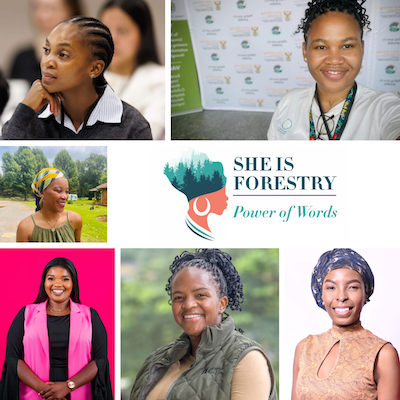
Ask a successful woman about the people who shaped her career and, somewhere in the story, there is often a person who opened a door, offered advice, provided an opportunity or simply saw potential before she did. For six women taking part in She Is Forestry South Africa’s (SIFSA) Mentor Me initiative, mentorship is not simply about receiving that support. It is also about what happens next: becoming the person who opens the door for someone else. Their careers span forestry operations, research, technology, communications, sustainability and certification, but their experiences share a common thread. Progress rarely happens alone. Yoliswa Dlamini, now a Management Forester at Sappi Midlands, to study Forestry at Nelson Mandela University’s Saasveld Campus. Today she is responsible for eight teams comprising around 145 people. Looking back, she recognises how much her career was shaped by people willing to invest in her. It is why she is now committed to helping young professionals and women coming into forestry build confidence, overcome obstacles and find their own paths. “For me, mentorship is a two-way journey. Just as I have learned from my mentors, I know I will also learn from those I mentor, while sharing what I have gained along the way,” says Dlamini. Nonkululeko Ntinga, Nurseries Manager at Mondi South Africa, was the first Black African woman to receive the Sir William Schlich Medal twice for academic excellence after her studies towards a National Diploma in Forestry from Nelson Mandela University and a BSc Forestry Honours degree from Stellenbosch University. She too has experienced mentorship from both sides. This laid the foundation for her to manage multidisciplinary teams, operational budgets and the production of high-quality clonal planting material. In 2026, Ntinga joined She is Forestry’s Mentor Me programme as being a mentee seemed like a natural progression that would broaden her perspective and strengthen her own …

More Than Trees: How South Africa’s Forestry Sector Grows the Economy
International Day of Forests highlights the economic potential of South Africa’s planted forests JOHANNESBURG - South Africa’s forestry sector contributes an estimated R8 billion to the country’s GDP, while supporting more than 150 000 jobs and livelihoods – many of them in rural areas where economic opportunities are limited. Beyond its direct contribution, the sector supports a further R58 billion in value-added activity across downstream industries, including sawmilling, pulp and paper, packaging and construction. Marking this year’s International Day of Forests (21 March), themed Forests and the Economy, Forestry South Africa (FSA) is highlighting the tangible role that sustainably managed planted forests play in driving inclusive economic growth. “The economic contribution of Forestry is often viewed through a very narrow lens, as a few large companies and obvious forest products, when in reality it’s a vast and diverse sector and its economic contribution reflects this,” says Dr Ronald Heath, Director of Research and Protection at FSA. Supporting jobs and livelihoods From planting and harvesting to transport, processing and manufacturing, forestry provides a stable source of income while sustaining a network of contractors, small growers and suppliers. Programmes such as Sappi’s Khulisa initiative are expanding this impact. The programme supports more than 4 400 small-scale growers and 1 000 SMMEs, supplying 5.9 million tonnes of timber from 34 000 hectares – creating an estimated R4 billion in value. Skills development initiatives, like Mondi’s Semi-skilled Artisan Initiative are also creating pathways into employment and enterprise, both within the sector and beyond. Merensky’s Komazi Woodwork Project is equipping unemployed youth with practical skills to start their own businesses, while supporting local schools through the production of desks and furniture. Strengthening rural economies through small growers Forestry is helping to unlock …
Track Your Press Release HERE:

Five Women Driving the Future of Forestry Through Science
Johannesburg – 11 February 2026 – To celebrate the United Nations International Day of Women and Girls in Science, Forestry South Africa (FSA) has launched two complementary campaigns to amplify women’s voices, inspire more women to pursue STEM careers in the field, and challenge outdated perceptions of the forestry sector. Modern forestry is not just about growing trees. It spans a wide range of STEM careers, including genetics, climate science, ecology, data science, engineering, logistics, planning and applied research. Across South Africa, women are leading important research in these fields, improving forest productivity, strengthening climate resilience and delivering tangible social and economic benefits, particularly in rural communities. “It’s not enough to recognise women in science – we need commitment and transformation across all industries and sectors,” says Dr Yolandi Ernst, senior lecturer at the Global Change Institute. “It sends a message to young girls that careers in environmental science, climate research and forestry are not only possible, but vital. Climate-resilient landscapes are built through science-based decision-making, and women are already central to that process.” Five women give a voice for science, sustainability and forestry The first campaign is a series of thought leadership pieces featuring women in forestry science who explore how research and innovation enable the sector to respond to global climate challenges and national economic growth and rural livelihoods. Professor Ilaria Germishuizen – Research Director, Institute for Commercial Forestry Research Professor Sanushka Naidoo – Programme Leader, Forest Molecular Genetics – Forestry and Agriculture Biotechnology Institute (FABI) Dr Yolandi Ernst – Senior Lecturer, Global Change Institute Dr Noxolo Ndlovu – NCT Forestry, Forestry Research Scientist Jacqui Meyer – Co-ordinator, Timber Industry Pesticide Working Group “Forestry research is a space …
Track Your Press Release HERE:

South African Chemical Industry to Tackle Process Safety at Upcoming Conference
JOHANNESBURG – FEBRUARY 11, 2026 – The Chemical and Allied Industries’ Association (CAIA) will host its Process Safety Conference 2026 on 4–5 March at the Business Leadership South Africa Auditorium in Sandton, bringing together industry leaders, safety professionals and academic experts to strengthen process safety practices across the sector. Deidré Penfold, executive director of CAIA, explains why the topic of process safety is imperative: “In the chemical industry, process safety is not just a plant-level concern; it underpins the entire value chain. It ensures that the way chemicals are manufactured, handled, stored and moved is managed responsibly, so that risks are controlled long before they result in injury or loss of life, and costly damage to infrastructure and capital equipment.” The two-day conference will provide a platform to explore global trends, share practical insights and reinforce a culture of safety in high-risk industrial environments. The programme features keynote presentations, expert panel discussions and real-world case studies designed to support organisations in managing complex safety risks and building resilient operations. Internationally respected process safety specialist David Moore, President and CEO of AcuTech Group, will deliver the keynote address. The programme also features contributions from leading specialists, including Dr Rohan Perera, CBRN risk?mitigation expert at CRDF Global; Terrence Moothusamy, director and technical signatory at MHI Risk Engineers; Samantha Kachikira, director and partner at ISHECON (Pty) Ltd; Charlene Wassenaar, former VP SHERQ at Natref and Process Safety Auditor at CAIA; and Tom Zhao, Vice President for Digital Power at Huawei South Africa. The event will focus on strengthening process safety culture, human reliability assessment, practitioner competency and regulatory frameworks, including the Chemical Weapons Convention, while also exploring the intersection of climate resilience …
Track Your Press Release HERE:

South Africa’s Urgent Need for Mentors and Role Models in STEM Career Landscape
Forestry sector marks International Day of Women and Girls in Science JOHANNESBURG - February 7th , 2025 - Despite progress, women remain underrepresented in Science, Technology, Engineering, and Mathematics (STEM) fields, making up just 23% of the workforce in South Africa*. In the forestry sector, where science and innovation play a key role in sustainability, Forestry South Africa (FSA) is calling for greater support to bridge this gender gap and unlock new opportunities for women in the industry. As the world marks the International Day of Women and Girls in Science on February 11, FSA highlights the urgent need for mentorship and role models to inspire young women to enter STEM careers. “While progress has been made in promoting gender equality, women remain significantly underrepresented globally in STEM fields,” says FSA’s Dr Katy Johnson. “Young women, especially in rural areas face unique challenges that often discourage them from considering opportunities in STEM sectors.” The theme for this International Day emphasises the vital role of mentorship in fostering a diverse and inclusive workforce. Mentors can provide essential guidance, support, and encouragement to young women, helping them navigate the complexities of STEM education and careers. "Initiatives like the She Is Forestry Role Model campaign have illustrated the power of introducing high school learners to relatable women—often from similar backgrounds—who are excelling in a variety of forestry career paths. FSA plans to do something similar with STEM. By creating a series of short clips featuring young women thriving in STEM careers, we hope to inspire others," notes Johnson, adding that this can help nurture future potential and talent. One such story is of forestry PhD student Shae Swanepoel. “My mother taught me that education is something that nobody can take away from you, and these words have encouraged me throughout my life to achieve my academic goals. I want to …
Track Your Press Release HERE:

Pretoria’s Most Loved Running Race Clinches Sappi as Its New Sponsor
The annual TuksRace has announced that Sappi, a global pulp and paper group, will take over as title sponsor of a favoured event in the South African athletics calendar. Hosted by the University of Pretoria (UP), TuksSport, and TuksAthletics, the Sappi TuksRace road running race is set to take place on Saturday, 15 February, starting and finishing at the UP Hillcrest Sporting Complex in Hatfield. The race offers four distances: a half marathon (21 km), a 10 km race, and a 5 km and a 1 km fun run, ideal for beginners and families. Renowned for its vibrant atmosphere, the event attracts a strong contingent of Pretoria-based students and residents, and runners training for the Comrades Marathon. As a company focused on health through its ‘MoveMore’ employee wellness campaign, Sappi is also no stranger to sporting events with its longstanding support of mountain bike and trail running races that wind through its timber plantations in Mpumalanga and KwaZulu-Natal. The company felt that it would like to have a presence in Pretoria, home to the Sappi Technology Centre, which will also be the location of the 18 km water point on the half marathon route. Commenting on the partnership, Sappi Limited CEO Steve Binnie said, “Sappi has an enduring academic and research relationship with UP that creates a space for students and young researchers to help advance a low-carbon bioeconomy.” “Our relationship with the University extends to scholarships and collaboration in forestry and engineering disciplines. At Sappi’s Innovation Hub, our scientists work closely with the University and CSIR, and many of our engineering scholarship holders study at UP,” Binnie added. Sappi will also sponsor the TuksSport Night Race, scheduled for September on the University campus. TuksSport director Steven Ball shared his enthusiasm for the partnership. “As TuksSport and the University of Pretoria, we are thrilled to welcome Sappi as the naming sponsor of our annual TuksRace and …
Track Your Press Release HERE:

South African badminton player on the road to Paris Olympics seeks sponsorship
Deidré Jordaan (27), an accomplished South African national badminton player, has been part of the South African squad since 2020. She has represented the country at African Championships in 2020, 2021 and 2022, competing in all disciplines of the sport (singles, doubles and mixed doubles). Most recently Deidré was selected as one of only two women to represent South Africa in Badminton at the Commonwealth Games in Birmingham, United Kingdom. Road to Paris Programme Deidré and her women’s doubles partner have been included in the Badminton Confederation of Africa’s (BCA) “Road to Paris” (RTP) programme. This programme has identified Africa’s most promising badminton players and show potential to qualify for the 2024 Olympic Games in Paris, France. Their inclusion in the programme is following their success at the African Championships held in February this year, where they achieved a silver medal. The objective of the RTP programme is to facilitate the attendance of these players at several African, Pan-American and other international tournaments to boost their world ranking with Badminton World Federation (BWF). To qualify for the Olympics, players will need to be ranked number one in their discipline (singles/doubles/mixed doubles) in Africa and among the top 50 in the world. Funding Requirement The RTP programme includes co-funding by BCA, however the funding is limited, and a significant portion of the costs must be covered by the local badminton federation or the players themselves. Currently Badminton South Africa (BSA) is unfunded, unsponsored, and awaits support from the National Lottery Fund or another sponsor. For these reasons, BSA is unable to provide any financial assistance to any of the South African players chosen for RTP. In pursuit of her Olympic dreams, Deidré is faced with little option but to self-fund the shortfall of R97,154 which will help her compete in the six identified tournaments over the next six months. CLICK …
Track Your Press Release HERE:

Sawmilling South Africa Carves Out a New Brand and Focuses on the Future of Wood
JOHANNESBURG – MARCH 28, 2022 – There is a crucial need to promote sustainable wood-based products in South Africa. In honour of International Day of Forests on March 21, Sawmilling South Africa (SSA) has turned over a new leaf to lead the way for the timber sector with a new logo and slogan, and a renewed focus. “Getting people to recognise the value of timber in the built environment will be set in motion by our modernised visual identity and corporate logo and will be directed by our new positioning statement: ‘We saw the future’,” explains Roy Southey, the association’s executive director. “A play on words, ‘We saw the future’ demonstrates that we use renewable and responsibly sourced timber to saw products that are aimed at the future of sustainable, low-carbon design, architecture and construction. It fundamentally embodies our vision for the timber industry in South Africa and globally,” says Southey. “There is a unique climate case for wood as it is deemed as the only structural material that can naturally and significantly decarbonise our planet, both through the growing of trees (which sequester carbon dioxide and release oxygen) and by harvesting them at the right time, which locks up the carbon in sustainable quantities for many years to come. In fact, trees absorb about two tonnes of carbon dioxide to create one tonne of their own (dry) mass[i],” he points out. SSA is an industry association that represents around 50 sawmilling companies, collectively employing approximately 12,000 people, predominantly in the rural areas of the country. Sawmills transform roundwood – in other words, logs – into a variety of sawn timber products, including structural lumber for the building and construction industry and industrial lumber for the furniture, joinery and packaging sectors. Globally, urban populations are burgeoning, requiring cities to become more dense, often by building upwards. At the same time, we are facing a climate crisis. The …
Track Your Press Release HERE:

South African cyclists raise over R110,000 for SA Harvest in virtual race
On Friday 24 April at 15:00, 105 cyclists started the v360km+ Ultra, a virtual cycling race not only to burn off some lockdown energy but also for a good cause – SA Harvest. There were no prizes. SA Harvest and the thousands of under-resourced hungry and homeless South Africans were the real winners. With an operating cost of R5 a meal, the R110 000 raised will support the delivery of more than 22 000 meals. Many of the riders were due to ride the annual 36One Mountain Bike Challenge in Oudtshoorn but due to lockdown, the event had been postponed to later this year. Not wanting the long hours and many kilometres of training to go to waste, avid Benoni-based cyclists Dion Guy and Aiden Choles decided to organise the v360 Ultra using the virtual cycling platform Zwift. “We also wanted to use the event to raise money for a charity,” explained Choles, who adds that riding for a cause helps to keep the motivation levels especially in the lonely, dark hours of the morning. Choles set up a campaign through the crowdfunding website backabuddy.co.za. Paying forward the calories burned towards food for others Hunger is becoming a serious problem in South Africa as the economic effects of the lockdown deepen. Vulnerable communities are severely impacted and the need for food is on the increase. “On endurance rides such as these, cyclists can burn up to 12 000 calories while also taking in significant amounts of food and liquids to sustain them. We thus encouraged people to pay forward the calories they would burn on this ride towards food and hunger support by donating to SA Harvest,” said Choles. Zwift tracks calories burnt as pizza slice equivalents, at roughly 285 calories each. “We asked riders to back themselves by sponsoring R12 for every slice burnt - you're likely to burn about 12 000 calories, so that’s 42 slices (or R500). Riders could also donate R1.50 per km (about R550)” A number of the cyclists were in it to race while others joined for the …
Track Your Press Release HERE:

Timber industry offers its resources and solutions to Government for housing and isolation units
Timber industry offers its resources and solutions to Government for housing and isolation units Johannesburg, April 30, 2020 – Sawmilling South Africa (SSA) and the Institute for Timber Construction South Africa (ITC-SA) have offered the South African Government their combined resources, skills and expertise as part of their sector’s response to the Covid-19 pandemic. One of the many pressures that the pandemic has placed on South Africa is the pressing need to thin out densely populated informal settlements to slow the spread of the virus. This means urgently providing alternative housing and infrastructure while at the same time addressing the need to shelter people who must remain in isolation or quarantine. SSA and the ITC-SA have approached Government with a proposal that timber be seen as one of the construction materials of choice, and as a longer term solution that will transcend the current crisis and immediate needs. There are several compelling reasons in support of timber. “To begin with, South Africa has a ready supply of sustainably grown timber, a product which is not only accessible but is light, easy to transport and lends itself to rapid construction,” says SSA executive director Roy Southey. In addition, timber-frame homes can be mass produced in panel form and speedily erected by an existing construction workforce that can be easily upskilled to assemble pre-manufactured, factory-checked units that not only address the current crisis, but provide permanent homes. Around 70% of people in the developed world live in timber-frame structures, yet South Africans have, in many ways, been conditioned to believe that building with brick and mortar is the only way. Correctly treated, wood is in fact highly durable and performs better than many other materials in the event of fire. Apart from complying with most municipal regulations, it also offers exceptional thermal insulation, is extremely cost-effective and is an environmentally …