
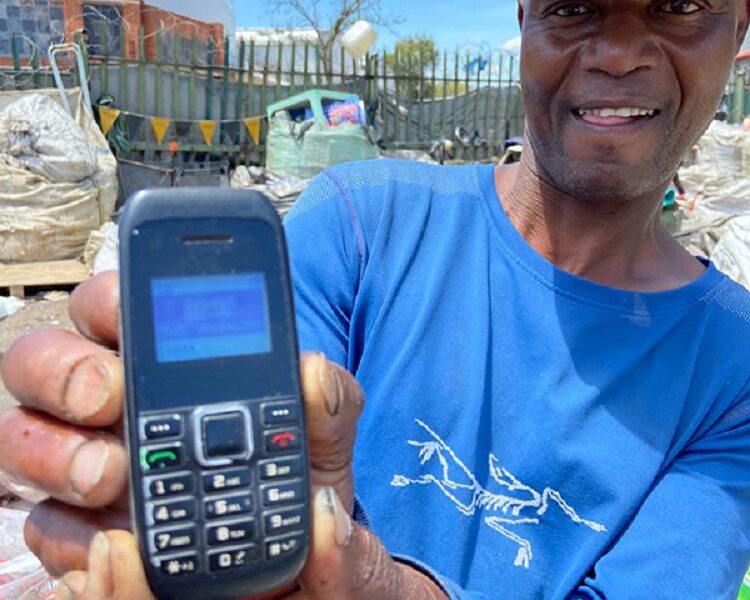
Innovative technology to track, trace and record the trading in recyclable materials is being rolled out across South Africa. The move is set to empower recycling SMMEs, strengthen the value chain and promote the economic inclusion of the informal sector. In a move set to revolutionise how recyclable materials are traded, tracked and traced in South Africa, an innovative technology called BanQu is being rolled out further to recycling buy-back centres across the country. The digital platform will help buy-back centres accurately record and track their recycling transactions with waste pickers – as well as trace the origins of the recycling – while providing a real-time business management tool enabling them to better understand and manage their businesses. South Africa’s PET plastic producer responsibility organisation (PRO), PETCO, is driving the rollout of the BanQu technology in a project called Up, which commenced in 2021 and is funded by The Coca-Cola Foundation. Over the next year, the system will be rolled out to 100 buy-back centres identified by PETCO across the country, with 10 centres in Gauteng, Limpopo and the Western and Eastern Cape who are live and transacting on the system so far. Once registered on the BanQu system, the buy-back centres can capture the quantity of recyclable material bought from waste pickers, as well as the price paid for it and where it was collected. This allows buy-back centres to know the quantity of all materials within their centres at any given time. The waste pickers, in turn, receive an SMS receipt for each transaction and can keep track digitally of their income earned through sales to various buy-back centres. To date the 10 live centres have registered over 1 400 waste pickers on the BanQu system, and more than 2 350 tonnes of recyclable material worth more than R5.7 million have been recorded. Suzan Banda was one of the first to register her buy-back centre in Etwatwa, Ekurhuleni, on BanQu earlier …

East Cape farmers go high-tech
PORT ELIZABETH – EYE-IN-THE-SKY technology is taking off within the Eastern Cape farming community, with a growing trend toward the use of drones to improve security, boost productivity and help reduce escalating costs. According to farmers’ organisation Agri Eastern Cape, there is no doubt that the use of drones will play an integral part in farming operations moving forward. More and more farmers are starting to use drones to do quick spot-checks on their farming operations without having to waste time trekking to remote areas on foot, according to Agri EC. This ranges from checking that boundary fences are secure, to checking on livestock, watering points and other critical operational issues. Joseph Ott, a conservation manager at a private reserve near Graaff-Reinet, said he started using his drone a year ago and has been reaping the benefits ever since. “We did some research and quickly realised that drones could make a huge difference to increase efficiency to gather critical information quicker and at a lower cost [than labour and transport],” Ott said. “Saving time collecting information is part of our monitoring and evaluation of our various conservation projects and is crucial to any farming and wildlife operation. Before, a large amount of time was taken up walking to various parts of the reserve [for inspections and monitoring]. The use of a drone cuts that work down by more than 50% allowing me to do more in the same amount of time. It’s a win-win situation any day of the week!” Ott said the drone allowed “the capability to search for very specific animals within a herd as well as local animals in inaccessible areas of the farm”. “The drone allows us to track animals, identify erosion areas and grazing impacts far more efficiently than in the past. We also use the drone for other operational purposes including the monitoring of soil erosion, stock, veld types and conditions, fences, security and infrastructure patrols.” Chris Lee …
Track Your Press Release HERE:

“Eskom crisis would have been worse” – Radebe
ENERGY minister Jeff Radebe praised the renewable energy sector’s contribution to socio-economic development as he officially opened the doors to a custom-built R4-million library for residents of the impoverished Sea Vista community in the Eastern Cape on Tuesday. Radebe was invited as a guest of Kouga Wind Farm, which provided the funds to construct the state-of-the-art facility, and Kouga Municipality, which made the land available and will manage the library as part of its community services portfolio. Delivering his keynote address, Radebe said that renewable energy was here to stay. “It is the policy of our government and renewable energy is going to save the world.” Radebe said the current challenges faced by Eskom “would have been worse”, were it not for the contribution from independent power producers such as Kouga Wind Farm, which contributes more than 280 gigawatts of electricity to the national grid per year. He said, as energy minister, he was determined to push forward the growth of the renewable energy sector to “not only fire up our energy but also to develop the communities where these projects are based.” The minister called on the Sea Vista community to take ownership of the library as a community asset which would help to break the cycle of poverty. “Education is the future for our children and a library is the fountain of knowledge in a community. “Treasure it and be its protectors because our children will depend on it to improve themselves,” said Radebe. Kouga Wind Farm’s community liaison officer, Trevor Arosi, said the library was a tangible and sustainable symbol of the wind farm’s commitment to development through education. Arosi said the three-year project had created 96 jobs during construction, injecting direct wages of R1.4 million into Sea Vista and that a further R1.3 million was spent on local procurement of materials. He said St Francis Bay residents and the local Rotary Club had embraced the …
Track Your Press Release HERE:

Empowerment deal boosts long-standing East Cape company
In a boost for 80 Nelson Mandela Bay families, one of the Eastern Cape’s longest-standing companies has finalised an empowerment deal with the Industrial Development Corporation (IDC) – to the benefit of its 80-strong labour force which now ranks as a shareholder. Thanks to the restructuring deal, Rhino Manufacturing – formerly known as Rhino Plastics which was launched 50 years ago – is now a B-BBEE Level 2 company. Since the new deal was signed late last year, business has taken off, making strides in the plastics recycling and manufacturing sector while strengthening its lead in the supply of plastic products to the construction, agricultural and the packaging sector nationally and into Africa. Under the new business structure, the 80 employees at the North End plant – who each support, on average, five dependants – now own a collective 10% stake in Rhino Manufacturing, with acclaimed local entrepreneur Siyabulela Mandla coming on board with a 41% shareholding, and the remainder held by Rhino Plastics, headed by businessman Brian van Niekerk. Mandla, a strong advocate for the upliftment of previously disadvantaged communities, said of the deal: “We have a responsibility to shape and improve the living conditions of our communities, where unemployment and inequality are our biggest challenges. It always inspires me to see business used as a catalyst for change in this regard.” Thirty-seven-year-old Mandla is a former regional SAB Kickstart, Seda Stars Business Competition and National Gazelles SME programme winner. His successful ventures include 469 Carwash & Café, 469 Bar Lounge & Butchery, Patapata Lifestyle, and Kasi Craft Beverages in Motherwell and New Brighton. “Thanks to the new deal, we are now geared to expand the company’s footprint and look into new opportunities in the public sector and into Africa,” said Mandla. “We are also looking at diversifying our product range to include products such as plastic droppers and poles, …
Track Your Press Release HERE:

Digital education boost for SA’s poorest pupils
IN a boost for South Africa’s ailing education system, business heavyweights are backing a plan to place a fully resourced e-learning tablet in the hands of one million of the poorest pupils within the next five years. Already MTN, Oxford University Press, Cambridge University Press, Shuter & Shooter and WIZZR Technologies have signed on with the organisation spearheading the plan, the Closed-loop Learner Network (CLN), resulting in a successful trial roll-out of the tablets – called Omang – to 1,000 pupils at no-fee schools in the Free State late last year. Based on the trial’s success, and together with the provincial Department of Education, a further 20,000 pupils at no-fee schools will be benefitting from the initiative during 2019. MTN provides free connectivity for the tablets, while CAPS-approved textbooks for grades 10 to 12 pupils are pre-loaded onto the devices thanks to international software developers WIZZR Technologies and the three textbook publishers. CLN in turn ensures that high school pupils receive the Omang devices, complete with textbooks, tutorials and white-listed online resources to assist them in their studies. The initiative was celebrated at a gala dinner in Bryanston this week [Thursday, March 14th], where private sector heavyweights including MTN’s David Mphelo* and SAP Africa head of innovation Dr Adriana Marais – who is a candidate for the Mars One human settlement mission – addressed the audience of 150 delegates. Included in the line-up of speakers were MD Ramesh, regional head of the multi-billion dollar agri business Olam International, as well as African Industrialist of the Year**, Jendamark MD Quinton Uren. Also in attendance were Massimo de Luca, head of trade and economics for the European Union delegation to South Africa, Danone Southern Africa MD Hendrik Born, and singer Danny K. CLN had already begun building the infrastructure required to implement President Cyril Ramaphosa’s vision of a tablet …
Track Your Press Release HERE:

20 years on – water brand’s community focus remains
KWAZULU-NATAL – WHEN members of a small Kranskop community drilled down in search of water to meet the daily needs of community members, they could not have known that from it would spring one of South Africa’s purest and most beloved bottled water brands – aQuellé. Found to be too pure for domestic use, the spring water “had to be bottled” and was introduced to the local market in 1998 – with immediate and unexpected success. Now, 20 years on, the water business continues to support community development projects, with 100% of the profits ploughed back into these initiatives. Reflecting on two decades as one of the country’s leading water brands, aQuellé managing director Arno Stegen said joy and thankfulness were the defining themes of the brand’s journey so far as well as its 20-year celebrations. Stegen said people, and especially the brand’s community work, had always been the driving force or the “why” behind the business. “The reason for our existence is our calling to help people in need and make their lives better. Therefore, by extension, aQuellé is not just about making profits but about giving the consumer a high-quality, affordable, value-for-money product.” This market strategy has seen a sustained growth in consumer demand, with the fully automated Kranskop plant continuously expanding from just 360m2 in 1998 to over 18 000m2 today, and the addition of a second bottling plant in Franschhoek in 2016 to provide the Western Cape with aQuellé’s natural spring water range. Whereas staff initially loaded product onto a few small bakkies by hand, aQuellé’s automated warehouse today has a 6,000-pallet storage capacity, with product distributed nationally via a dedicated fleet of delivery trucks. After starting out with the natural water range plus four typically South African flavours including marula and naartjie, aQuellé today bottles 13 flavoured variants and the natural range, each with its own customised, lightweighted bottle in …
Track Your Press Release HERE:

East Cape farmers’ resilience ‘being tested’
Agri Eastern Cape president Doug Stern has called on the province’s farmers to stay on their land despite facing the triple financial threat of unrelenting drought, raging veld fires and land expropriation without compensation. As the drought entered its fifth straight year, Stern said stock farmers’ cashflow had been dealt an additional blow in the form of falling commodity prices due to the recent outbreak of foot and mouth disease. Describing the drought as “one of the worst farmers have had to endure, due to its intensity”, he said summer heatwaves had resulted in the further deterioration of the veld. “More importantly, this has impacted dramatically on our farmers’ water resources, with borehole levels dropping almost daily and surface water drying up completely, resulting in major livestock water supply problems.” Stern said, over the past four years, farmers had recorded annual rainfall figures varying between 30 and 70% below what their average annual rainfall should have been. “The official word from the weather authorities is that we can expect the prevailing dry conditions to continue, with no significant rainfall being predicted. However, we as farmers believe that rainfall is always possible.” He said agricultural producers’ cashflow had been stretched extremely thin, as they had been spending large sums of money for long periods with the purpose of keeping their animals and lands in a productive condition. “2018 was an incredibly tough year for farmers throughout the Eastern Cape for a number of reasons. “Our farmers are renowned for their resilience. However, this resilience is now being properly tested by the climatic conditions we are expected to deal with on a sustained basis, without any support from the state to date.” Despite this, Stern said he had every confidence that the province’s farmers would survive the drought, as previous generations had done, by standing together and doing their best to remain productive …
Track Your Press Release HERE:

New challenges face EC farmers after rains
PORT ELIZABETH – GOOD rain in recent weeks has relieved some pressure for Eastern Cape farmers, but with cash flows all but exhausted thanks to the drought, the future is still far from certain. According to Agri Eastern Cape president Doug Stern, farmers in the province have been under great pressure for four concurrent seasons, in which they have received “way below average rainfall”. “The recent rains were great news for some, with the level of the Kouga Dam rising from an unsustainable 7% to over 50%,” said Stern. “But while that takes the pressure off farmers in the Hankey/Patensie area, who are reliant on that water to produce crops from potatoes to citrus, it does not help the rest of the province, especially the northern areas where there are huge problems due to the extremely cold weather experienced in August and September. “The late, unexpected cold weather was not conducive to vegetation growth. That, and also there is a desperate need for follow-up rains.”Stern pointed out that, due to the drought, many farmers’ cash flows had been exhausted. “The only thing which saved many farmers from going under is the huge increase in commodity prices for red meat, fibre and citrus [creating higher revenue for cash-strapped farmers]. Without that increase, results would have been disastrous for all concerned,” he said. “The downside, of course, is the effect on already hard-hit consumers, with these prices expected to remain inflated for at least five years as farmers try to rebuild their herds.” CLICK HERE to submit your press release to MyPR.co.za. …
Track Your Press Release HERE:

aQuellé travels SA to bring “triple the joy” to needy communities
KWAZULU-NATAL – aQuellé recently concluded their “Triple the Joy” campaign which saw the brand travel over 4800 kilometres across South Africa and distribute bottles of water and gifts to children and adults in underdeveloped rural communities. The three-month campaign, which ended in August, followed the #SpreadTheJoySA” summer campaign. That campaign introduced consumers in the major centres of Durban, Cape Town, Johannesburg and Port Elizabeth to three limited edition sparkling water flavours – watermelon, granadilla and apple. According to aQuellé managing director Arno Stegen, the public response had been such that all three limited edition flavours rolled out for the campaign had been added to aQuellé’s permanent line-up. “We had intended to choose just one flavour when the campaign ended, but the public voted in favour of keeping all three. In response, we also multiplied our giving back to the community,” said Stegen. The aQuellé new flavour mascots visited non-profit organisations in three provinces, distributing bottled water, meals and donations such as gazebos, playground equipment, schoolbags and stationery to beneficiaries. “The premise behind the community campaign was that joy is meant to be shared. So, we asked the public to share stories on social media about organisations they knew of that deserved a bit more joy. We were really touched by what we heard and selected four to visit,” said Stegen. The campaign kicked off in May with a visit to the Careways Siyanakekela Centre in KwaNdengezi, KwaZulu-Natal. Here intellectually impaired adults meet once a week to learn basic skills and take part in activities that help them to build self-esteem and find their place in the community. In June, the team visited the Goldhill Legends Netball Club in Mitchell’s Plain, Cape Town. The club draws players as young as seven from the impoverished communities of Hanover Park, Lavender Hill, Delft and Mitchell’s Plain, keeping them off the …
Track Your Press Release HERE:
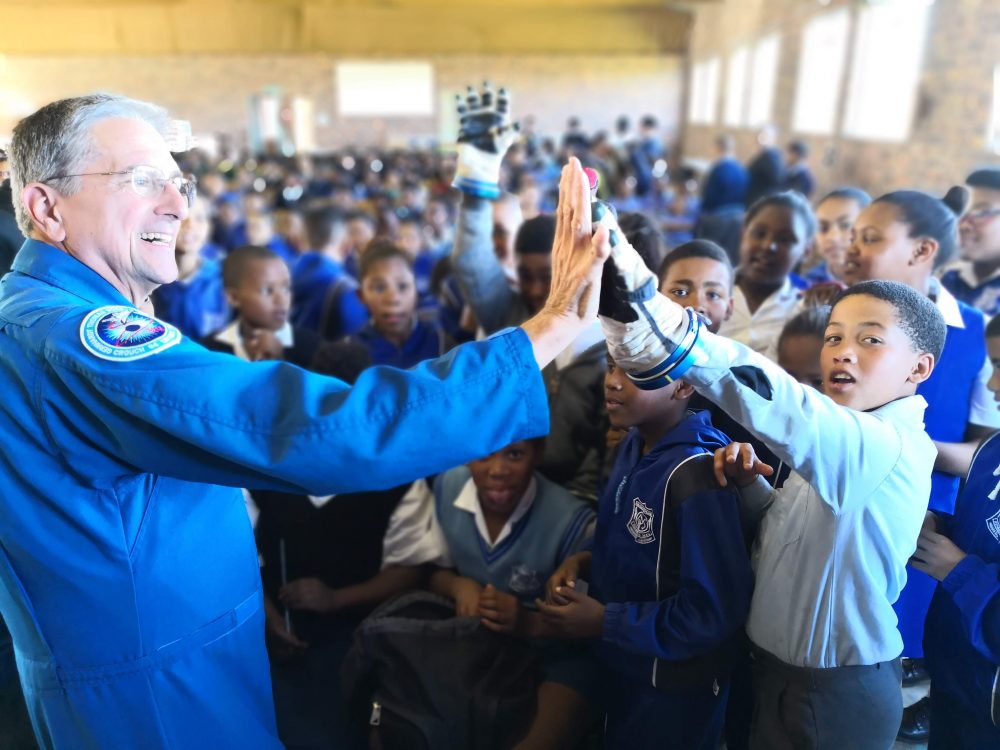
US astronaut has East Cape youth transfixed
UMZAMOWETHU, OYSTER BAY – ABOUT 1,000 pupils, their parents and teachers flocked to the Umzamowethu Community Hall on Heritage Day to meet US astronaut Dr Donald Thomas and listen to him speak of how – despite his humble beginnings – he became an intrepid space traveller. Thomas was visiting the community on invitation of the Kouga Wind Farm, as part of the Eastern Cape leg of his tour which started in Cape Town earlier this month (September 16). After visiting pupils in Port Elizabeth on Tuesday, he wrapped his tour on Wednesday (September 26) in Grahamstown. The talk formed part of Kouga Wind Farm’s sustainable development drive in the communities within its geographic footprint, with education being a key area of investment. Among the wind farm’s many other community upliftment programmes is a R4-million custom-built library and IT centre launching later this year. Addressing the pupils, Thomas detailed the many obstacles he overcame, including growing up in an impoverished home without a dad and, on many occasions, even without food on the table. He had to work hard to earn scholarships for university in order to land the education he needed to become an astronaut, he told pupils. “Never let anyone tell you that you can’t do something,” he told the star-struck youngsters, stressing the importance of never giving up on one’s dreams and that hard work really does pay off in the end. “You should be willing to work hard towards your dreams and not be deterred by those that tell you it can’t be done,” he said. Thomas also described what it was like to fly in a space shuttle and answered questions from pupils which included how he managed to eat, sleep and even use the toilet in outer space. During his 20-year tenure with NASA, which included four historic shuttle missions, Thomas logged over 1,000 hours of adventure in space and completed 692 orbits of the earth. His inaugural mission aboard the STS-65 Columbia in July 1994 set a new flight …